Friday, December 01, 2006

Books invasion!

We are having our book fair this week and many remarkable figures like: José Saramago, Gabriel García Márquez and Rigoberta Menchu have visited the city. This event has grown every year and it seems this year is at least as successful as others.

I have had the oportunity to get some nice books, for example some nice lecture notes from UNAM in perturbation theory and variational calculus.

One really remarkable book I have just found is: Differential Equations: Theory, Technique and Practice by George F. Simmons and Steven Krantz. This book is at freshman-sophomore level (for an excelllent advanced text look for the text by Arnol'd ) and is, hands-down one of the best math textbooks I have ever read, it includes many interesting applications (Hamilton's principle, Lagrange's equations, Kepler's Laws, Vibrating membranes, Pursuit curves) and almost always succeeds in delivering crystal clear explanations of the topics it treats. Not only that, it really feels like a modern textbook and includes many topics not found at this level: Sturm's separation and comparison theorems, Liapunov functions, Poncaré-Bendixson theorem and stability of dynamical systems. It also includes a chapter on calculus of variations, and many historical notes. I really wish the course on ODE's I took was half as interesting as this book. Despite some places where I think a further discussion is necesary (like the Fourier transform and numerical methods) and some turgid passages (Picard's theorem could a bit clearer) this is the obvious choice for an student wanting to learn differential equations and enjoy the ride. (And, no, the publisher isn't paying me, I really like this book).

I also got the relativity book by W. Rindler and it seems to be a welcome addition to my library (If you want my recommendations, use: J. Hartle's Gravity for undergrad and Sean Carroll's Space and Geometry for grad students, Schutz, MTW and Wald are standard books and there is much to learn from them). By the way, can someone recommend me some book on thermodynamics-statmech that is actually readable?

On other topic, maybe you have already watched the pathetic show (1)(2)(3) displayed by our lawmakers, even if it may look the country is in crisis, actually life is going as usual and most of this silly events don't have much importance at all (besides generating press coverage). One interesting thing will be to watch Calderon's attitude toward scientific research, Mexico has one of the lowest science budgets (at least in terms of the gross income) in the OCDE, let's see if this finally changes.

Wednesday, November 22, 2006

An historic day for mexican astronomy

Today the LMT (Large Millimeter Telescope) has been inaugurated today by president Vicente Fox. This telescope is a landmark in mexican astronomy. The LMT is the largest single dish radiotelescope working in the millimetric wavelengths (1-4 mm). It is located in the top of Sierra Negra, a 4,640 metres (15,223 feet) mountain in Puebla that was chosen for it's high altitude and dry air that avoids atmospheric absortion of millimetric radiation.


The LMT has a diameter of 50 metres and was a 150 millon investment that was built in 10 years ina cooperation between INAOE and UMass.

Millimetric wavelenghts are usually emitted in the coldest and densest places in the universe, this are the most oscured enviroments in the universe (the earliest stages of structure formation usually take place in sites) and observations at high resolutions had been scarce (there are also plans for large interferometric arrays at this wavelenghts like ALMA), this powerful new instrumention will finally allow us to solve some long standing problems in astronomy like high mass star formation.

The main scientific goals of the LMT are studies of structure formation in the universe, for example it will allow to observe directly the molecular cores where star formation takes place. It will also allow observations of the dust disks around young stars allowing us for first time a glimpse into planet formation. Other interesting proyects planned for the LMT are observations of some dusty starburst galaxies at large redshifts, obervations of the AGN's and studies of the center of the Galaxy that is remarkably difficult to study because the dust blocks light in almost all wavelengths, actually almost all our knowledege of the galactic core comes from radio wavelenghts, so this new window will surely give us many surprises.

Saturday, November 18, 2006

Watch for earth-gazers

If you are living in New England and the eastward parts of New York State and Quebec watch out for the leonids. This are particles from the comet Temple-Tuttle and are usually a meager show, but every 33 years the Earth enters in a particullary rich part of the stream, this actually happened in the 1998-2002 period, with the 2001 leonids beeing the most remarkable meteor shower in decades, so we are out of the "sweet spot".

Despite that, today (saturday 18) the earth passes through a narrow and dense part of the filament, if you live in the zones mentioned above then at around 11:45 pm east time (04:45 UT) you can expect a nice show, Leo won't be quite high in the sky so don't expect a literal rainfall of the meteors, the nice thing about tonight's meteor shower is that the meteors will enter the atmosphere at a low angle producing very long trails known as "earth gazers". If you are lucky enough to watch this from one of this places please leave a comment!

So, stop reading this and look in the direction of the Leo constellation, now! If you don't know where to look you can use the skycharts at SkyTonight.com.Look for more details (inclyding a map of the trail) here, if you can't see the country in the map (like me) you are out of luck.

Sunday, November 12, 2006

Science is for everyone, isn't it?

In 1995 Roger Schlafly found a very large prime number and then somehow managed to patent it! Can you really "patent" a number? Well, it seems the answer is yes, but legal issues aside the whole notion of pateting numbers lacks any sense, at least for me. So, are technological patents a good idea?

The central problem is that while patents might somehow encourage sharing information because at least everyone can see the patent and eventually the patent will expire (compare it with secrecy like the coke recipy that might never be known) the current "lawsuit culture" has gone to really funny extremes and some very nasty ones like software patents (you need to pay royalties for patented things like scroll bars, at least in principle).

I have just read an unbelievably funny story in this regard (even funnier than Sagan vs Apple), it seems that Kimberly-Clark was using some patterns quite similar to Penrose Tilings in toilet paper, of course Mr. Penrose (who has done many remarkable things in mathematics and physics) didn't liked such a close link with the lavatory and sued Kimberly-Clark! You can read an account here.

Personally I find that science belongs to everyone and there is no sense in trying to prevent it's widespread use, even in the lavatory.

Wednesday, November 08, 2006

Setting up your scientific workstation

Usually setting up your computer as a scientific workstation has been a very time consuming activity, for MacOS users scisoft has been avalaible for a long time (it also has a version for Fedora Core 3) and includes most of the software that an astronomer is likely to use and it is useful for practically every other branch of physics, after all the numerical, ploting and statistics software has lots of applications.

Now a very useful script is avalaible for Ubuntu, it is called scibuntu and will turn your ubuntu system into a scientific workstation in a snap.

Friday, October 06, 2006

The culture of corruption

Raymond Fisman and Edward Miguel published a quite interesting study. They wanted to study the cultural influence on corruption and devised a way to do it: they measured the parking violations of diplomats in NYC.

Because of diplomatic inmunity there is almost zero enforcement of the law, so the cultural effects should be evident. The results are quite interesting:

As you can see in the figure the countries with the most negligent diplomats are also countries with high indexes of corruption and poverty. Of course we can argue if corruption causes poverty or poverty causes corruption. Which are the countries with no parking tickets? Unsurprsingly enough: Canada, Israel, Norway, Sweden, and Denmark. This are highly devoloped countries, showing again the correlation between poverty (or lack thereof) and corruption.

My opinion: the only reason for diplomats for parking where they pleased is the culture of corruption, they knew they could do it and get away with it, so why not doing it? This is the kind of mentality that keeps countries in the thirld world.


Nobel prize for the COBE team

As you might already know, the Nobel was awarded to John Mather and George Smoot, the leaders of the COBE project that measured the CMB determining it's blackbody form and detected anisotropies on it (this anisotropies are the seeds of the structure in the universe), this was a turning point in the history of cosmology allowing for first time a detailed comparison of cosmological models with CMB (which is esentially a "picture" of the universe when it cooled enough to allow the presence of neutral atoms). According to the Nobel Prize committee, "the COBE-project can also be regarded as the starting point for cosmology as a precision science.

The most detailed study of the CMB has been carried by the WMAP satellite and it is consistent with the predictions of inflation which makes us believe we are on the right track. ESA expects to launch the Planck Surveyor probe in 2008 which will complement the studies of WMAP and might even be capable of detecting the polarization in CMB due to gravitational radiation.

Congratulations to Mather and Smoot!

Sunday, October 01, 2006

Nobel Hype 2006

The winners of the Nobel Prize in physics will be announced next tuesday. I don't have any firm prediction but I am willing to hear the ones from you!

In the field of astrophysics this prize was never awarded to its greatest figures: E. Hubble, the greatest observational astronomer of the last century who opened the whole fields of extragalactic astronomy and observational cosmology and Y. Zel'dovich who was the greatest astrophysicist of all times, is simply almost impossible to work in a field to which Zel'dovich didn't made a contribution: the theory of nuclear chain reactions, the physics of plasmas, black holes (he was one of the first to develop evidence of the "no hair" black holes, he also proposed them as the mechanism behind quasars), the evaporation of black holes, the production of monopoles in the early universe and many other contributions in other fields including chemistry and optics.

Of course there are many fields of physics with probable candidates (David Deutsch, Peter Shor or Anton Zeilinger,or the Sudbury neutrino experiment for example), I will only speculate on astrophysics. Ignoring the fact that the Nobel has eluded some of the best in the field I think that the inflationary trio (A. Guth, A. Linde and P. Steinhardt) has a very good chance of getting the prize. The more we study the CMB, the more consistent it seems with the inflationary scenario, despite that we lack a 100% confidence in it, although the vast majority of cosmologists consider the inflation as the correct answer, and that is also my own opinion.

In the observational field there is an obvious Nobel candidate: The two teams that discover the aceleration of the expansion of the universe (hands down the most important discovery of the last decade in all physics) and the COBE team for discovering anisotropies in the CMB. Dark matter also deserves a Nobel Prize but there are too many names associated with, altough V. Rubin is the most common and there is no doubt of the existence of dark matter, so she another solid candidate.

Play the game! I'd like to hear your suggestions.

Saturday, September 16, 2006

Dissecting movies

I have recently landed a website with a very noble cause: dissect the bad physics in movies. The website is called insultingly stupid movie physics. Of course most of us go to movies just for fun, but Intuitor seems to attend movies with the only purpose of analyzing its physics.

This site features some generic stupid movie physics and reviews of particular movies with ratings going from GP (good physics in general) to XP (obviously physics from an unknown universe).

Have fun.

Thursday, August 24, 2006

Au revoir Pluto!

The rumours started last tuesday and today were confirmed: The IAU did not aproved the proposed redefinition of a planet that would many members to the planetary neighborhood, not only that, now Pluto is no longer a planet!

This was the correct decision (so we finally admit there was a mistake made more than 70 years ago) but I was surprised when the news arrived on tuesday that most astronomers not only wouldn't vote the proposed definition but actually wanted Pluto out of town. I definitely didn't expected that the IAU would demote Pluto as a planet, mostly because astronomers have always been very much conservative, take the horrible magnitude system as an example (we have a very ugly system for measuring fluxes that was made only to agree with some measurements done in the classic Greece!).

On the other side the decision to call Pluto a member of a new class of planets, the plutons, instead of just calling it a planetoid is silly and was fortunately rejected so Pluto is now a "minor planet". The obvious name for this kind of objects is planetoids and everyone out there is using it but somehow the IAU doesn't thinks that, but well... what can I do on that regard?

Monday, August 21, 2006

The Smoking Gun

This morning in a press conference the first direct evidence of the existence of dark matter was announced. As I previously mentioned the conference was about the Bullet Cluster, a quite remarkable cluster that consists of two colliding clusters of galaxies. Let's put it clear and loud, this shows undeniable evidence dark matter exists and there isn't any need for modyfing the laws of gravity (at least for macroscopic scales).

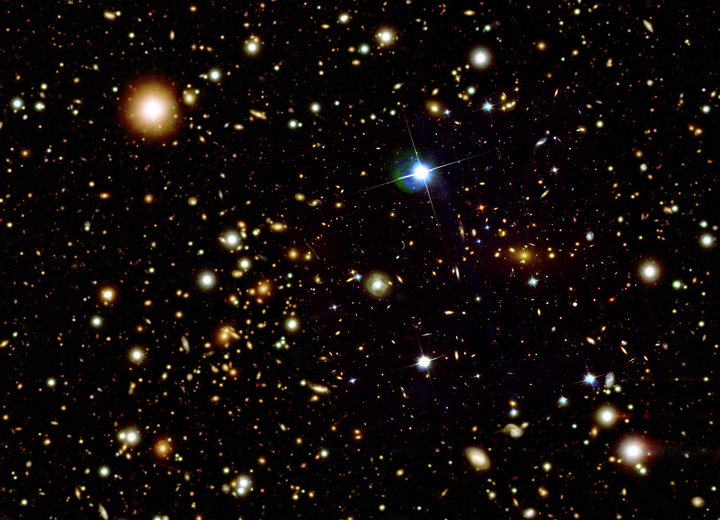
This is the Bullet Cluster at optical wavelenghts, the bunch of galaxies in the upper right form one of the two interacting subclusters, in the bottom left corner you can the second (and smaller) interacting cluster.


The concept of dark matter isn't really that new, it was proposed by Fritz Zwicky in 1933 who realized from observations of the Coma Cluster that the speeds of the galaxies in the cluster were too high to keep the cluster bounded, he realized the mass of the cluster should be 400 times greater to keep it together and although later observations showed some of this mass there was still less than the required to explain the motions of the galaxies. We have now evidence in many clusters, also the mass infered from gravitational lensing is always bigger than the mass from the observed galaxies, even in our own milky way the stars in the outer regions of the spiral disk orbit at higher velocities than we should expect from the observed mass.

There are two straightforward ways to explain this observations:

  1. There is more mass than we observe, this can be because it cames in the form of cold objects than don't emit much light (like the funny named MACHOs and brown dwarfs) or from some kind of matter that interacts very weakly with "normal" (baryonic) matter (these are called WIMPS, an obvious and funny match for the rival of baryonic matter). The latter explanation is much favored because the MACHOs and brown dwarfs seem to contribute only a small fraction of the missing mass.
  2. We need to modify the laws of gravity, a particular popular model of this type involves a modification of inverse square depence of gravity and is called MOND. Despite its problems in explaining some observations regarding gravitational lensing it was (until this morning) a more or less viable explanantion.

After observations with the Chandra X Ray Telescope Markevitch et al (1,2) it was possible to observe the gas component of the cluster (in clusters of galaxies most of the mass -around 90%- is in the form of a very hot gas that emits x rays) and it showed clear evidence of a recent interaction between the two clusters. This collision heated the gas even more, as far as I know this is the hottest known cluster.

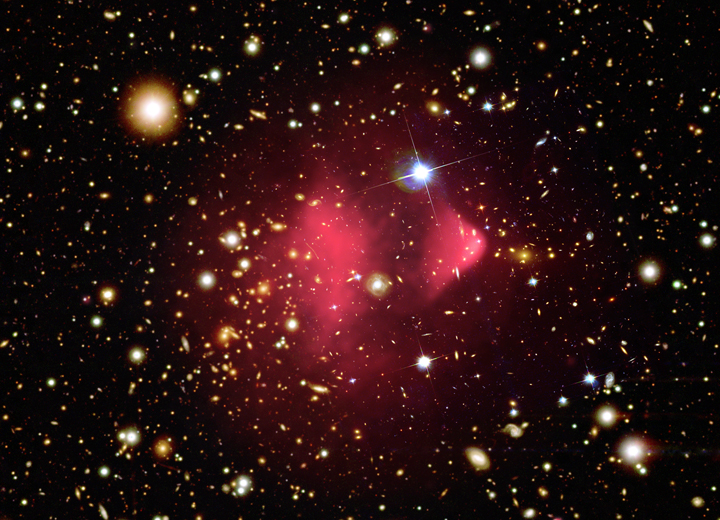
The Bullet Cluster in x rays is shown in the pink zone of the picture. Two shock front on the right corresponds to the smaller cluster, this front has the highest mach number of all the known intergalactic medium
The most interesting part comes now, the galaxies in the clusters actually don't crash and rather pass by without changing that much, but the remaining matter in the gas forms about 90% of the mass of the cluster and we can use the x ray observations to see if the source of gravity points in the same direction where most of the observable mass is located. What makes the Bullet Cluster so special is that the galactic component is separated from the gas element, as dark matter (by definition) interacts very weakly if it interacts at all it will be in a position similar to the galactic component that passes almost unperturbed the interaction.

But how can we know where gravity comes from? One of the most surprising predictions of Einstein's theory of general relativty is that gravity can bent light in the so called gravitational lenses, the paper by Clowe et al (3) shows the weak lensing map of the bullet cluster maping the location of the mass in the cluster.

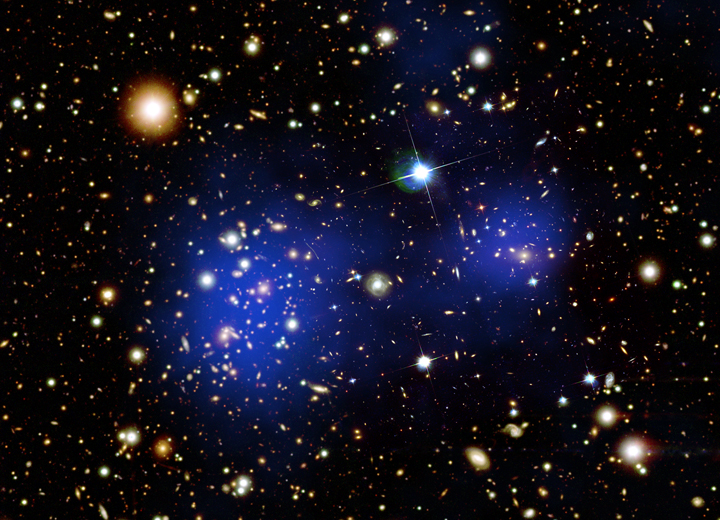
The blue part of the picture maps the position of the matter causing the weak lensing in the background galaxies. As it turns out it is a map of the dark matter of the cluster!

Now, if you expect that the laws of gravity should be modified to explain the rotation curves in galaxies and the motions of galaxies inside clusters then you should expect at least that the weak lensing map points in the same direction of the observed matter, after all it's gravity should produce the weak lenses. It turns out that both the weak lensing and xray maps are well separated with the weak lensing map in the same position of the galactic component just as expected from dark matter!

This image shows the x ray emission in pink and the position of the mass causing the weak lenses in blue, as you can see most of the mass of the cluster is not in the observed xray emission and is actually just in front of the observed galaxies clearly showing that it has not interacted with the hot gas component. If this is not convincing enough for you then anything will be.

This shows conclusively that most of the matter in the Bullet Cluster is not in the observed x ray emission (and much less in the observed galaxies) but in an "invisible" component that only manifests through its gravitational presence. You can see here an animation of how we think this process happened. There is simply no way to fit any alternative theory of gravitation in it, the principal source of gravitational mass is simply not observed in any light wavelenght. Regarding the composition of dark matter this is one of the biggest unsolved problems in astronomy and physics, my personal guess is that is composed mostly of axions and light supersymmetric particles (the lightest supersymmetric partner turns out to interact really weaky and is stable as it can't decay into a lighter particle), but again it's just my guess.


Images courtesy of NASA, you can see more images here.

Thursday, August 17, 2006

What a week !!!

This week has been really active in astronomy: There is some new discovery about dark matter that deserves a press conference on next monday (from the participants list that includes Cosmic Variance´s Sean Carroll and Maxim Markevitch I can bet it will regard the Bullet Cluster, John Baez actually has the same guess) this cluster is really interesting and it certainly deserves a future post in this blog (maybe before monday´s press conference) , a team reports to have found the limit between main sequence stars and brown dwarfs and it is 8.2% of the mass of the Sun, but undoubtely the event that is getting most attention is IAU´s new definition of a planet that is going to be discussed at IAU´s reunion in Prague.

Actually this is not a redefinition of the planet concept, the truth is that we have never had a definition at all! The reason is that of the current nine accepted planets six were known since prehistoric times (when people used FORTRAN and hunted woolly mammooths) because they are easy noticeable in the sky (changing it's position everyday and not blinking as stars). When W. Herschel discovered Neptune and the posterior finding of Uranus (which was predicted by theoretical calculations!!!) it was clear that they were very similar to the known planets so there wasn't much contreversy.

Using the same theoretical arguments it was expected that a ninth planet would eventually emerge and Clyde Tombaugh eventually "found" it at Lowell Observatory in 1930. It was only decades later when it's "moon" Charon was found and it became possible to approximate Pluto's mass, this mass is so small that it has a negligible effect on the orbits of the other planets (another interesting feature of the Pluto-Charon system is that the center of gravity of this system is outside of Pluto, so both orbit a common center somewhere between them) so the question remained open and the existence of a "Planet X" was expected (at least by a few astronomers). Today we know that the data used for the "theoretical" prediction of Pluto was simply wrong and there is nothing as a "Planet X", although high precission measure of the orbits of the probes Pioneer 10 and 11 seem to point to some source of perturbation a major planet is not in the possible explanantions.

Recently the problem of defining a planet has emerged from two principal sources:


  • The extrasolar planets found using diverse techniques seem to be way more massive than Jupiter (the most massive planet in the solar system) and some of this planets were found so close to it's star that it challenged the model of planet formation of that time and it's still a bit problematic. It was hard to know where planets end and stars begin.
  • Searches for trans-neptunian objects started to show "minor planets" that are of almost of the same size of Pluto, actually one of them, Quoar, seemed to had the same size as Pluto, then some even bigger transneptunian objects were found like 2003 UB313 (Xena), Sedna, Orcus and 2005 FY9.

This has generated much controversy about what is a planet, as our current list of planets seems to include an object that is esentially a big asteroid (Pluto) and some really big extrasolar planets that are almost stars. So the IAU has proposed the following definition:

A planet is a celestial body that (a) has sufficient mass for its self-gravity to overcome rigid body forces so that it assumes a hydrostatic equilibrium (nearly round) shape, and (b) is in orbit around a star, and is neither a star nor a satellite of a planet.

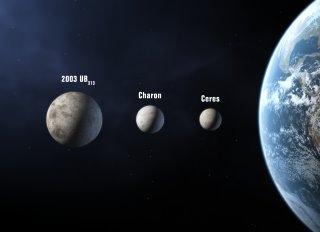
Using this definition the solar system would increase inmediately to 12 (planetary) members, and the new folks in town will be: Ceres, Charon (so the Pluto-Charon system would be considered a double planet) and Xena. There are other obvious candidates like Quoar that would enter the planet definition as soon as astronomers confirm their properties. The definition also includes a new class of planet: pluton that applies to all planets similar to (ughh) Pluto.


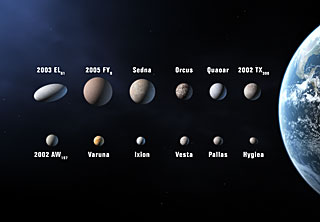
These are the "new" planets, one of them (Ceres) has been considered for long time as an asteroid of the asteroid belt between Mars and Jupiter.

In my personal opinion this "new" definition is nonsense, despite it is based on a scientific and unambigous definition it simply adopts a "leave no big icy rock behind" and this "new" solar system is way too messy (specially for the public, after all the definition isn't really that much relevant for astronomers), the solar system will have eventually hundreds of planets that have little (if any) in common like Ceres and Jupiter. Not only that, this definition is completely ambigous on the other end of the spectrum and leaves the separation between brown dwarfs and big planets as blurry as it can be. It is expected that the resolution will be decided on August 24th. Many of my peers are in Prague waiting impatiently the result of this resolution, I will inform you about it as soon as I can.

Look at some of the new candidates for planets, all them are very small, actually some of the moons of Jupiter and Saturn have the double (or more) of its size. Just compare the size of Vesta and Pallas (in the asteroid belt) with the size of the earth.

Monday, August 14, 2006

Some astronomical humor

I recently landed up in this page (almost by accident), if you have ever done data reduction then you might want to take a look at it. Despite I have never used AIPS, I am somehow familiar with IRAF and the "paleolithic mysticism" is also there, and yes the "painful blows" described there are mostly true. Happy reading.

Friday, July 28, 2006

A regional view

This certainly won't be new to anyone in the region but is important to summarize Latin America 's position in science and technology, and the results are terrible. In a report done by the Inter-American Development Bank (get the numbers here, also check the report on higher education) the data was hard to believe. As an example the whole region spends $11 billion in research and development, this might sound like an awful lot of money but now consider that a single asian country, South Korea, expends $12 billion, more than all the latin american region!

The reasons for this are difficult to pinpoint, but as far as I can say the whole topic isn't in the political agenda. In the past electoral process the candidates rarely mentioned it, maybe they just expected that inversions will arrive to a country that is unable to create any new product. In this regard Mexico registers the ludicrous amount of 82 patents a year! Argentina registers 62 patents and the regional leader, Brazil, registers 130 patents a year. There are many US universities that register many more patents. Let's compare this numbers with Asia, Japan registered 36 000 patents, South Korea around 3000 and China (that has comparable or higher levels of poverty) registered 300.

The research is sponsored mainly by the state which is a rare situation in the world. In the "communist" China 61% of R&D is paid by the bussiness sector in contrast with the 32% in Latin America. The bussiness sector inversion in R&D of course isn't the result of some philantropic ideology but the result of effective state policies, as an example many american universities get money for research from donations that many companies do in exchange of fiscal privileges. But don't expect that transnational companies will put their money in countries with high taxes, inefficient spending, legal uncertainty (remember Evo Morales seize of refineries and oil extraction plants or the seizure of bank deposits in Argentina in 2001).

Even more important, Latin America lacks the necessary human resources to attract R&D inversions that usually go to places like India or Singapur. Take the microprocessors company Intel as an example, most of the region's countries were shocked when Intel decided to move its inversions to Costa Rica (where president Arias removed the army and used those resources for education) instead of the obvious candidates: Mexico, Brazil and Argentina. Even further in the past Intel had looked at the region for a big R&D plant but eventually decided to do it in Haifa, Israel (which is now under fire, literally). In this regard the educative levels are pathetic, in the PISA mathematics test the average score of mexican students was 385, the american students scored 483 and japanese students 534.

Which are the results of this lag in science, research and education? The results are that the region is the slowest-growing one in the development world, while Latin America is projected to grow by 3.7 percent in 2007, sub-Saharan Africa will grow by 5.4 percent, the Middle East and North Africa by 5.1 percent, South Asia by 6.2 percent, East Asia by 8.1 percent and Eastern Europe by 5.1 percent. It is imperative for the region to understand that the current situation is untenable: the oil prices won't be sky-high forever and the agricultural and metal export prices increase will certainly decrease in future.

In a region where its leaders speak about the recent export bonanza as the product of their economic wisdom, the future might be gray when the bonanza bubble bursts unless the correct measures are seized. Certainly science, research and education should be the prioritary model for the region's growth and as Ireland and Asiatic example shows, it works.

Thursday, July 13, 2006

Blasting out black holes from the galactic disk

A recent paper (1) shows that the black hole X-ray binary XTE J1118+480 might be an ejected black hole from the galactic disk. This system consists in a small star orbiting a black hole, it was discovered in the year 2000 and it was since then an interesting object because of its location in the metal poor galactic halo.

Using the 10 m Keck telescope the spectra of the small star has been observed and surprisingly enough it was very rich in metals (remember that in astronomy anything else from hidrogen and helium is considered as metal, this is because this elements are synthetized inside the cores of stars, elements heavier than iron are believed to form in supernova explosions) suggesting it might actually be a double star from the galactic disk (where the metal abundance is much higher than in the halo), when the massive star in the system went supernova it might caused an asymmetrical blast (by the so called "acoustic mechanism") that expelled the system from the galactuc disk (2).

After reading the paper it seems to me that the metallicity is way too high, it's even higher than the Sun, this means that

  • This is a relatively recent event so the star is from a later generation than the Sun, so it formed from a mollecular cloud with a higher metal abundance.
  • As I mentioned before some of this heavy elements are formed in supernova explosions, making the assymetric natal kick not so necesary, after all.

Because the estimated age of the small star is around 5 Gyr, so the first scenario is very likely and certainly (almost) discards the origin of this system inside a globular cluster.

Saturday, July 08, 2006

EurekaUK

There is a recent report from UK universities about the most remarkable discoveries done in UK universities, in a previous post I had done a similar thing for the mexican case.

Despite some points in which I disagree, like the claim of the contraceptives which were first sintetized in 1951 by Luis Miramontes in Mexico who was aware of the contraceptive use of norethindrone (the work in 1961 by Herchel Smith produced cheaper contraceptive pills which is of course a significant advance, but it seems clear that the report try to sell the idea that contraceptive pills are an UK invention which is false), and also the CFC stuff where the really important role was played by Crutzen, Molina and Rowland (again the work of James Lovelock was an important precedent, but it seems to me they are trying to oversell it), this kind of reports are really important because many countries are facing serious problems with research budgets.

In the case of Mexico the situation is of near disaster with only 0.34% of the gross domestic product going to research despite some countries invest more of the 10%. This situation has only resulted in that most of the inversions in technology have gone to Asia where the situations is radically diferent, let's see how the new president faces this challenge.

Wednesday, July 05, 2006

No the best possible outcome

We still don't have an official result of the elections, the cause is simple: Andres Manuel Lopez Obrador has acussed everyone of massive fraud, including the loss of 3 million votes (the votes were indeed in the Prelimary Results Program, so this was completely disproved) and has threatned threatened with massive protests and said: "The stability of the country is at stake" (1). The prelimary results with 98.5 of the votes counted showed that PAN won by around 1% (around 400 000 votes), after counting the 3 million votes that are hold the PAN still wins by 0.6% (250 000 votes). With such a close election, has said Andres Manuel Lopez Obrador "The political stability of the country hangs in the balance." and it seems clear he simply won't accept his defeat soon.

This photo actually portraits very well my impressions of this protests, the placard says "fraud" next to the the latest elections since 1988 (actually the election of 1988 is widely regarded as fraudulent, and even one of the candidates died on suspicious circunstances after the election), despite since 1994 the IFE has organized the elections and all of them had been considered as valid by international organizations. The top of the placard acusses of the fraud the PAN, PRI (their principal competitors) and TV Azteca (this is completely ridiculous, despite it dubious antecedents I don't see how this TV network can alter the ballot boxes). I won't even comment about the URSS flag...

This is one of the worst scenarios, the PRD won't accept its defeat, and the stocks have already lost 4.3%. The IFE has decidied to recount every vote tallie.

As of 8:59 PM the results are PRD: 36.45 and PAN:34.83 but many districts in which PAN had most of the votes aren't counted yet. Wait, now at 9:15 are rumors the count has halted!!!

Update: The rumor was simply false and the stocks have been stable recently, this recount has actually showed the same results: in the preliminary results Calderón won by 0.6%, in the recount he won by 0.57%. Obrador has impugned the election and has treatened with more protests, has acussed the IFE of being a corrupt and fraudulent institution, called Vicente Fox a traitor to the country and even acussed his own representants of selling out. This will only affect his own political future, personally I just want him to shut up.

Monday, July 03, 2006

Not yet...

We still don't have an official winner of the election, the election is simply too close for call and the results will be announced until wednesday. It seems that Felipe Calderon has won but we only have 9% of the votes counted, in the election for legislators exit polls show that PAN has 35% of the votes and PRD a 31%.

Despite who turns out to be the next president, the PRI which ruled for more than 70 years before Vicente Fox has now falled to the third place! I don't have any idea if the PRI is prepared for this. The other source of concern regards Andres Manuel Lopez Obrador who has hinted won't accept a defeat by a close margin, there are some concerns about movilizations, but let's wait until wednesday for that.

Sunday, July 02, 2006

Elections day

Today we have elections for president and in some states (including Jalisco, where I live) we also have governor elections.

Amazingly enough, Mexico city has what I perceive as two rather good candidates: Demetrio Sodi and Beatriz Paredes, the amazing part is not only having decent candidates, but that the exit polls show that Marcelo Ebrard who was sacked by Vicente Fox after Ebrard refused to help three federal police officers who were lynched in Tlahuac is winning with 52% of the votes! During the hours long incident which ended in the death of two of them and included officers' pleas for help in national TV, authorities refused to send any kind of reinforcements, later videos showed that Ebrard was aware of the situation but refused to act because he was in a precampaign act. He also famous for wasting millions of dollars for Giuliani's services that didn't improve the security in Mexico city at all. The only reason I find for this is that PRD has been able to emulate the structure of PRI the party that ruled Mexico for more than 70 years, after all most of the people surrounding Ebrard and Obrador are well known members of Carlos Salinas de Gortari cabinet.

Andres Manuel López Obrador was Mexico City's mayor at the time of the incident and said that he would never use the public force, even in extreme situations as lynchings, he also mocked of the million of participants in march demanding the end of the recent insecurity wave, when months later were released TV ads showing victims of kidnappings and encounters with criminals he said he was the"victim of a complot". A few months before members of his cabinet were videotaped receiving millionare bribes from Carlos Ahumada and Carlos Ponce (the minister of finances) was videotaped gambling huge amounts of money in Las Vegas, a few days ago Ahumada's wife threatened to show more videos involving more López Obrador collaborators, and later suffered an attempt on her life, this videos are now believed to be lost. He is now the leading candidate for the presidency, don't even try to ask me why.

In the local election for governor Emilio González Marquez seems to be the winner of the elections, at least from exit polls that show he has 46% of the votes. The campaign for local elections was pathetic, even worse than the federal one and just consisted in a trade of insults and acussations, including acussations of narcotrafic, corruption and homesexuality. Of course this only results in most people view of politcs as the less honorable job in the world.

Law prohibits the release of any kind of result regarding the federal election before 9 PM in local media, I don't know if this blog is considered as a local media, but I will remain on the safe side. Maybe some international media releases some information, surely a web search can help in that regard.

Saturday, July 01, 2006

Still alive

After a brief hiatus I'm back to action. Actually it seems a lot of things happened recently including a failure of Hubble's main camera, an expresident got a warrant order, and, of course, the World Cup (Mexico lost against Argentina...), and I still can't believe what happened to Denice Denton. Meanwhile I have been deciding where to go for vacations, a small town in Austria seems quite interesting...