So, what happened with all this CDMS fuzz? The collaboration reports 3 events out of a expected background of 0.5. Nonetheless, one of the events was out of the "box", so lets forget about it. So, with 2 events we have a 1.06 sigma signal and with 3 events we have a 1.7 sigma signal.
It is just a ridiculously low signal, and by no means can be considered a discover. Nonetheless, it is rather interesting and intriguing. Experiments using liquid targets have a significantly bigger mass and can catch up this signal in one, maybe two years to a level where it can actually be considered a detection, but, until then, the coin is still in the air regarding dark matter.
Friday, December 18, 2009

Thursday, December 17, 2009
CDMS results in a few hours!
As most of you know, there is a rumor about CDMS getting some of sort of signal from its dark matter search. Well, in a few hours we will know if all the fuzz around it was justified.
CDMS stands for cryogenic dark matter search. It is a solid state detector designed to "listen" the sound made by dark matter particles when they interact with the nucleus of the atoms in the detector. These interactions cause the nucleus to recoil, as a result of that the atoms in the detector (which are arranged in a lattice) vibrate and produce phonons (some sort of quanta of sound). This signal can be measured and used to detect the interactions of weak interacting particles.
Now, this is only a very simplified description of the experiment. The practical difficulties are huge. First of all, random thermal vibrations can wash away very easily any signal, so the detector must be kept at really low temperatures. Then, collisions with cosmic rays will also spark the detector as fireworks, for this reason the detector is located underground in a deep mine in Minessota. But, how about other "backgrounds" like nuclear decay of particles in the rocks surrounding the detector? Well, the study of systematic backgrounds is really an art. One way to calibrate the detector is to place it close to some radioactive source and use the signal gathered this way to callibrate the detector.
Early in the year, I saw the results of the CDMS collaboration and there was no signal (or hint of it), so it is hard to think that the results that are about to be announced will have 5-sigma signal (the usual threshold accepted as a detection), but maybe they got some sort of provocative signal at a smaller sigma level. Or maybe all the fuzz was just that, fuzz.
Anyway, we will know the answer in a few hours!
CDMS stands for cryogenic dark matter search. It is a solid state detector designed to "listen" the sound made by dark matter particles when they interact with the nucleus of the atoms in the detector. These interactions cause the nucleus to recoil, as a result of that the atoms in the detector (which are arranged in a lattice) vibrate and produce phonons (some sort of quanta of sound). This signal can be measured and used to detect the interactions of weak interacting particles.
Now, this is only a very simplified description of the experiment. The practical difficulties are huge. First of all, random thermal vibrations can wash away very easily any signal, so the detector must be kept at really low temperatures. Then, collisions with cosmic rays will also spark the detector as fireworks, for this reason the detector is located underground in a deep mine in Minessota. But, how about other "backgrounds" like nuclear decay of particles in the rocks surrounding the detector? Well, the study of systematic backgrounds is really an art. One way to calibrate the detector is to place it close to some radioactive source and use the signal gathered this way to callibrate the detector.
Early in the year, I saw the results of the CDMS collaboration and there was no signal (or hint of it), so it is hard to think that the results that are about to be announced will have 5-sigma signal (the usual threshold accepted as a detection), but maybe they got some sort of provocative signal at a smaller sigma level. Or maybe all the fuzz was just that, fuzz.
Anyway, we will know the answer in a few hours!
Wednesday, September 23, 2009
Fixing unrecognized File Type extensions in Ubuntu
I've had a little 'bug' in my Ubuntu for the past month that was annoying me a bit. I use TeXmacs for creating/editing small LaTeX documents. The problem is that Nautilus was incorrectly detecting the file type of .tm files, thinking they were plain text documents (see image below). The consequence is that TeXmacs files would be opened in gedit (or the default text editor) when opening them through the Nautilus file browser.

The first solution attempt was right-clicking a .tm file, going to "Properties -> Open With" and changing the default application to GNU TeXmacs. This was a disaster, since now *all* plain text files would be opened in GNU TeXmacs, since Nautilus genuinely believed a .tm to be the same as a .txt and thus changed the default application for all text files.
My second attempt at a solution (after googling a bit) was checking the MIME file type associations, which is the way Ubuntu associates an extension to a file type. The info is all in the file /etc/mime.types. However, to my disappointment, this file already contained a mime type for TeXmacs documents, indicated by the entry
"text/texmacs tm ts". So even though the mime type was correctly recognized, it seems Nautilus wasn't picking it up. This could be further deduced from the fact that running the command file on a .tm document in the terminal returned the correct mime type.
After more googling, I finally discovered that this is in fact a bug and found a fix for it:
http://savannah.gnu.org/bugs/?25938#discussion
Essentially, you manually create an xml file describing the TeXmacs mime type to /usr/share/mime/packages and then manually update the mime database of the system (setting an icon for the file type is optional, but may be useful).
NOTE: the original poster of the above bug fix made a small typo: an extra semicolon (;) at the end of the line containing "mime-info xmlns=" Remove it before trying to update the mime database.
After this is done, logout / re-log (or simply kill / restart nautilus from the terminal) and the new file extension should now be recognized:

The nice thing about this is that it should conceivably work for any other file type that has a correct mime type in /etc/mime.types but is not being recognized by Nautilus.
Hope this was helpful ;).

The first solution attempt was right-clicking a .tm file, going to "Properties -> Open With" and changing the default application to GNU TeXmacs. This was a disaster, since now *all* plain text files would be opened in GNU TeXmacs, since Nautilus genuinely believed a .tm to be the same as a .txt and thus changed the default application for all text files.
My second attempt at a solution (after googling a bit) was checking the MIME file type associations, which is the way Ubuntu associates an extension to a file type. The info is all in the file /etc/mime.types. However, to my disappointment, this file already contained a mime type for TeXmacs documents, indicated by the entry
"text/texmacs tm ts". So even though the mime type was correctly recognized, it seems Nautilus wasn't picking it up. This could be further deduced from the fact that running the command file on a .tm document in the terminal returned the correct mime type.
After more googling, I finally discovered that this is in fact a bug and found a fix for it:
http://savannah.gnu.org/bugs/?25938#discussion
Essentially, you manually create an xml file describing the TeXmacs mime type to /usr/share/mime/packages and then manually update the mime database of the system (setting an icon for the file type is optional, but may be useful).
NOTE: the original poster of the above bug fix made a small typo: an extra semicolon (;) at the end of the line containing "mime-info xmlns=" Remove it before trying to update the mime database.
After this is done, logout / re-log (or simply kill / restart nautilus from the terminal) and the new file extension should now be recognized:

The nice thing about this is that it should conceivably work for any other file type that has a correct mime type in /etc/mime.types but is not being recognized by Nautilus.
Hope this was helpful ;).
Friday, September 18, 2009
Goodbye MP3s!
The story - skip to the end if you only want the scripts and could spare my self-righteous opinion.
I've used MP3 as my music compression format for years, as I'm sure most people have, without thinking too much about it. But my relatively recent ascension into Free Software has changed my perspective on many things related to software. Especially, it has given me the awareness that, in general, as a user I am the one in charge and I have the power to choose what I want to use and how I use it - or at least I should.
MP3 entered the equation when I learned that Apple iPods do not play any other music format except WAV, MP3 and ACC related codecs (such as M4A). The reason for this is simple: these are patented, proprietary compression formats that Apple supports in order to introduce DRM (copy protection), using iTunes as a centralizing vehicle. While I can't deny their right to do so, I do believe this sort of policies go against the realization I exposed in the previous paragraph.
I don't own an iPod. I have this small, very practical, albeit ugly, 2GB iBit music player that I bought at Sam's Club for under $80 that will play MP3, M4A, FLAC, OGG and pretty much any format I've thrown at it. Why would this small company support OGG while Apple does not? Would Apple lose business if they did?
So, exercising my right of decision, I've abandoned the MP3 format in favor of free alternatives: OGG for standard music compression and FLAC if I ever need lossless compression. Converting all my music to OGG is no easy task, however, mainly due to the size of my music collection. In Windows, I'd probably have to find a small utility that can do the batch conversion, and it probably would cost me something.
Fortunately, Linux is rooted at the most fundamental level on the basic premise that the power belongs to the user (as opposed to Apple's diametrically opposed mindset), and it provides countless tools that allow you to perform complex tasks with a minimum effort. So I took this as an opportunity to learn a bit about bash scripting and wrote a small script to handle the conversion for me.
The script
Here's the link to the source code. Copy/paste to your favorite text editor, save and set execute permission (chmod +x mpeg2ogg.sh).
mpeg2ogg.sh
The script assumes you have two programs installed in your system: mpg321 and oggenc. The former handles MP3 decoding and the latter compression to OGG. If you don't have them, you can most certainly get them through your favorite package manager (in Debian/Ubuntu, all you need to do is a sudo apt-get install mpg321 vorbis-tools).
Using the script is simple. Navigate to the root directory of your music library (in my case this was /home/meithan/Music), copy the script there (or put it in a dir in your path), and run it . It will find all MP3s in the directory tree rooted in the current directory, and convert them all to OGG. The script builds a list of all the files that it finds and uses it as a queue: every time a file is converted, it removes that entry from the list. Thus, you can stop the script whenever you want, and just run it again at a later time and it will resume where it had stopped (reading from the file list.txt).
A note: since I still don't trust my bashing abilities enough, the script won't delete your original MP3 files. You should first try the OGG files first, and then, if you're confident the conversion was successful, manually delete your old MP3s. Now, since "manually" means something completely different in Linux, here's a minimal script that will batch remove all MP3s in the current directory and its subdirectories:
mp3del.sh
Hope my ranting and/or bash hacking are useful to someone.
I've used MP3 as my music compression format for years, as I'm sure most people have, without thinking too much about it. But my relatively recent ascension into Free Software has changed my perspective on many things related to software. Especially, it has given me the awareness that, in general, as a user I am the one in charge and I have the power to choose what I want to use and how I use it - or at least I should.
MP3 entered the equation when I learned that Apple iPods do not play any other music format except WAV, MP3 and ACC related codecs (such as M4A). The reason for this is simple: these are patented, proprietary compression formats that Apple supports in order to introduce DRM (copy protection), using iTunes as a centralizing vehicle. While I can't deny their right to do so, I do believe this sort of policies go against the realization I exposed in the previous paragraph.
I don't own an iPod. I have this small, very practical, albeit ugly, 2GB iBit music player that I bought at Sam's Club for under $80 that will play MP3, M4A, FLAC, OGG and pretty much any format I've thrown at it. Why would this small company support OGG while Apple does not? Would Apple lose business if they did?
So, exercising my right of decision, I've abandoned the MP3 format in favor of free alternatives: OGG for standard music compression and FLAC if I ever need lossless compression. Converting all my music to OGG is no easy task, however, mainly due to the size of my music collection. In Windows, I'd probably have to find a small utility that can do the batch conversion, and it probably would cost me something.
Fortunately, Linux is rooted at the most fundamental level on the basic premise that the power belongs to the user (as opposed to Apple's diametrically opposed mindset), and it provides countless tools that allow you to perform complex tasks with a minimum effort. So I took this as an opportunity to learn a bit about bash scripting and wrote a small script to handle the conversion for me.
The script
Here's the link to the source code. Copy/paste to your favorite text editor, save and set execute permission (chmod +x mpeg2ogg.sh).
mpeg2ogg.sh
The script assumes you have two programs installed in your system: mpg321 and oggenc. The former handles MP3 decoding and the latter compression to OGG. If you don't have them, you can most certainly get them through your favorite package manager (in Debian/Ubuntu, all you need to do is a sudo apt-get install mpg321 vorbis-tools).
Using the script is simple. Navigate to the root directory of your music library (in my case this was /home/meithan/Music), copy the script there (or put it in a dir in your path), and run it . It will find all MP3s in the directory tree rooted in the current directory, and convert them all to OGG. The script builds a list of all the files that it finds and uses it as a queue: every time a file is converted, it removes that entry from the list. Thus, you can stop the script whenever you want, and just run it again at a later time and it will resume where it had stopped (reading from the file list.txt).
A note: since I still don't trust my bashing abilities enough, the script won't delete your original MP3 files. You should first try the OGG files first, and then, if you're confident the conversion was successful, manually delete your old MP3s. Now, since "manually" means something completely different in Linux, here's a minimal script that will batch remove all MP3s in the current directory and its subdirectories:
mp3del.sh
Hope my ranting and/or bash hacking are useful to someone.
Wednesday, February 25, 2009
Coolest fish ever
The world is full of surprises and this amazing fish is certainly one of them. This 6 inch wonder is called Macropinna microstoma and features a transparent head!
The fish, discovered alive in the deep water off California's central coast by the Monterey Bay Aquarium Research Institute (MBARI), is the first specimen of its kind to be found with its soft transparent dome intact.

Now, that small orifices in the front of the fish are not its eyes but a smelling organ. The barrel eyes are inside the green barrels and can be rotated inside the transparent head, giving this fish a quite wide visual range.

The barreleye lives about 2000 feet under the surface, where it just stays floating with the eyes looking upward, when a prey arrives they usually have to steal it from siphonophores (jellies that can grow to more than 33 feet). To make this feat it rotate its eyes and goes straight for its prey! Quite amazing.
Monday, February 09, 2009
The universe, yours to discover
As probably all of you know by now, 2009 is the "year of astronomy", a sort of celebration of the 400th anniversary of the first astronomical observations using a telescope by Galileo (of course it is arguable if he was the first to do it, nevermind).
Of course this blog will join this, so you may expect more posts here, it has been rather complicated posting to this site, it is always hard to grab some time specially since many posts that are intended to be just "quick posts" end up consuming a significant amount of time. It also seems to me that you can do lots of nice posts that will be quickly erased of everyones mind but you are always dangerously close to make some comment that might annoy someone, of course that will change when I get tenure!
Anyway, lets see how this year unfolds!
Of course this blog will join this, so you may expect more posts here, it has been rather complicated posting to this site, it is always hard to grab some time specially since many posts that are intended to be just "quick posts" end up consuming a significant amount of time. It also seems to me that you can do lots of nice posts that will be quickly erased of everyones mind but you are always dangerously close to make some comment that might annoy someone, of course that will change when I get tenure!
Anyway, lets see how this year unfolds!
Sunday, June 22, 2008
Summer time
The semester has ended and it's time for the summer adventures, certainly this summer promises to be loaded of adventure for me. Hopefully the posting frequency will increase, which is quite a good thing as this blog has been rather inactive lately.
Right now I have just arrived to CRyA (Center for radioastronomy and astrophysics) to continue a collaboration on hypercompact HII regions (this regions are where massive star formation takes place, more on that on a some near post). The cab driver as soon as he heard I was an astrophysicist (student, of course) instantly replied: "but that's just an awful lot of f.....n maths", and proceeded to tell me the stories of "all those crazy geniuses" like Dali, Einstein, Newton and that "nut economist" (don't ask me who that nut economist is), at the end of the trip I guess he had the impression that he thought I'm every bit as crazy as them (but way dumber than them), which is fine, at least I'm in good company.
Right now I have just arrived to CRyA (Center for radioastronomy and astrophysics) to continue a collaboration on hypercompact HII regions (this regions are where massive star formation takes place, more on that on a some near post). The cab driver as soon as he heard I was an astrophysicist (student, of course) instantly replied: "but that's just an awful lot of f.....n maths", and proceeded to tell me the stories of "all those crazy geniuses" like Dali, Einstein, Newton and that "nut economist" (don't ask me who that nut economist is), at the end of the trip I guess he had the impression that he thought I'm every bit as crazy as them (but way dumber than them), which is fine, at least I'm in good company.
Monday, April 21, 2008
Join the PAM!
There is a nice project started by Julien Girard called wikiPAM, the idea behind this project is creating a wiki for the mexican astronomical community (the name comes from Proyectos Astronómicos Mexicanos, or Mexican Astronomical Projects). Anyone doing any sort of research in astronomy with a mexican group can get an account there and post their work.
This portal has a lot of potential, you can post your code (or modifications to it), your data, an announcement for your future projects... It seems to me like a wonderful tool for a grad student looking for a thesis project.
As far as I know it is possible to post there information only accessible to people in the same research group, so you can also use it to share confidential information to the rest of your group without anyone else seeing the data before it is made public.
There is also a portal for astronomical societies (i.e. amateur astronomers) in Mexico, it is called Cosmowiki. If you can read spanish look at this interesting account of the first mexican connection to internet that I found at cosmowiki, clearly showing its potential for outreach.
I conclude this small post inviting you to join this nice idea, you "only" need to be involved in research that somehow has the participation of the mexican astronomical community in it (for example having mexican astronomers in your group, or using mexican instrumentation like the LMT).
Monday, April 14, 2008
National astronomy meeting
Tomorrow starts the national astronomy meeting, this is the only event of the year when all the astronomical community meets in a single place and it's also a great occasion for seeing old friends from other institutions. I'll be participating with some of my work in regions of massive star formation.
Hopefully I'll be posting soon about the interesting stuff that emerges there.
Saturday, March 01, 2008
A new kind of supernova
We are sure that at least two kinds of astrophysical black holes exist, one kind correspond to black holes of stellar mass (around 8 times the mass of the sun or bigger) and the black holes at the centers of galaxies with millions of solar masses. For some time there was speculation about the existence of some intermediate mass black holes with masses around few thousands the mass of the Sun, evidence from the rotation of stars in globular clusters gave the first evidence for the existence of intermediate mass black holes.
Despite evidence from the rotation of stars around the centers of globular clusters, the case is far from closed, the centers of globular clusters are regions of high density, filled with degenerate stars (mostly white dwarves) and maybe the rotation speeds can be explained by an overabundance of stars. A new paper (available here) by Stephan Rosswog, Enrico Ramirez-Ruiz, and William R. Hix proposes a radically new method for searching this black holes.
In close binary systems composed by a red giant and a white dwarf, the white dwarf can steal some matter from the red giant star (which has a low surface gravity), matter falling into the white dwarf has angular momentum and as a result of that an accretion disk is formed, white dwarves are supported against gravitational collapse by electron degeneracy (essentially if you try to pack electrons too closely they will start to move faster as a consequence of the uncertainty principle), this degeneracy can only support a mass of about 1.4 solar masses (otherwise the electrons would move faster than light), this is known as the Chandrasekhar limit, so when the white dwarf has "stealed" enough mass from its companion it will eventually surpass this limit, in this case the star is reignited by a mechanism known as carbon deflagration, creating a supernova explosion of the IA type.
Now, enter intermediate mass black holes. Computer simulations including gravity, hydrodynamics and nuclear physics show the effects of a close interaction between a white dwarf and an intermediate mass black holes. The star is heavily disrupted by tidal effects and acquires a pancake-like form, as the star is squeezed there is a dramatic increase in pressure and the star is reignited and creates a new kind of supernova, around half of the mass is ejected and the other half falls into the black hole creating an accretion disk that should emit x-rays.
 This image shows the interaction of a white dwarf and a black hole, the star is heavily deformed in the first two frame, in the intermediate frames the star reignites and explodes, the "bubble" is the ejected material and at the bottom left corner an accretion disk is formed, the last two frames follow the evolution of this disk.
While this supernovas should be much scarcer than usual IA supernovas, new surveys like the LSST should detect enough supernovae to have a good chance of detecting this events, and x-ray emission should be detectable by the Chandra Space Telescope. The light curve should be different, although I haven't seen any detailed model. Considering that globular clusters are composed mostly of old stars and large populations of white dwarves this events should be happening relatively frequently around the universe and might give us unequivocal evidence of intermediate mass black holes.
Sunday, February 17, 2008
Back to classes
This weeks have been a bit hectic, the new semester has started and I have been busy handling endless tasks (which is why I haven't posted much in these days).
This semester I will lecture for half of the general astronomy course, mostly about celestial mechanics (Keppler's laws, tides, Roche lobe and Lagrange points) and some practical optics (mostly the types of telescopes and the effect of diffraction on a telescope's resolution). The later half of the course is about stars and galaxies but I won't be lucky enough to lecture about that.
This seems to be a good place to hear your opinions/ideas about this kind of courses, I have always believed that these courses should be accessible to sophomores (or even freshmen), and with an emphasis on stars, galaxies and the universe more than an "applied physics" course (specially with central forces being discussed in most classical mechanics courses and the Rayleigh limit in optic courses), this could serve the double purpose of exposing students to the wonderful ideas of astronomy even if they lack a strong physics background and help to lure students in to the more advanced astronomy courses. What do you think?
This semester I will lecture for half of the general astronomy course, mostly about celestial mechanics (Keppler's laws, tides, Roche lobe and Lagrange points) and some practical optics (mostly the types of telescopes and the effect of diffraction on a telescope's resolution). The later half of the course is about stars and galaxies but I won't be lucky enough to lecture about that.
This seems to be a good place to hear your opinions/ideas about this kind of courses, I have always believed that these courses should be accessible to sophomores (or even freshmen), and with an emphasis on stars, galaxies and the universe more than an "applied physics" course (specially with central forces being discussed in most classical mechanics courses and the Rayleigh limit in optic courses), this could serve the double purpose of exposing students to the wonderful ideas of astronomy even if they lack a strong physics background and help to lure students in to the more advanced astronomy courses. What do you think?
Friday, January 25, 2008
Star formation 101. Part 1
The time has come to pay one of the old debts of this blog: A mini-course on star formation. The night sky is full of little twinkling stars, but despite their obvious abundance its formation is still far from being a closed case.
Gravitational collapse (a cloud of interstellar gas collapses and produces stars) is the obvious way to produce stars , but it leaves us with a startling question, we can estimate the time of this collapse using the expression:

which is called the free fall time and as you can see it only depends on the density of the cloud and not of its size, for a typical cold cloud this time is around one million years, this is obviously problematic because we know galaxies are much older than that and we can observe star formation in practically every spiral or irregular galaxy.
This indicates us that other forces are acting on molecular clouds, slowing the process of gravitational collapse. There are four hurdles that star formation has to overcome, as we will see in this star formation series it is surprising that even a single star can overcome this hurdles! This hurdles are:
In future post I expect to explain you how each of this hurdles can be overcome and give an overview of this two paradigms.
Gravitational collapse (a cloud of interstellar gas collapses and produces stars) is the obvious way to produce stars , but it leaves us with a startling question, we can estimate the time of this collapse using the expression:
which is called the free fall time and as you can see it only depends on the density of the cloud and not of its size, for a typical cold cloud this time is around one million years, this is obviously problematic because we know galaxies are much older than that and we can observe star formation in practically every spiral or irregular galaxy.
This indicates us that other forces are acting on molecular clouds, slowing the process of gravitational collapse. There are four hurdles that star formation has to overcome, as we will see in this star formation series it is surprising that even a single star can overcome this hurdles! This hurdles are:
- The pressure hurdle: A homogeneous, spherical gas cloud is stabilized against collapse by its own pressure gradient. This means that the temperature of the cloud despite being small still implies enough energy for the particles in the cloud to overcome their own gravitational attraction. We can estimate the size at which the cloud is doomed to collapse, this is called the Jeans radius and is given by
where k is Boltzmann's constant, T the temperature of the cloud, m the mass of the particles and n the numerical density of particles. The Jeans mass is simply, when we plug numbers into it we realize that stars similar to our Sun require cooler and/or denser regions than the average of the interstellar medium. This regions are the molecular clouds.
- The dynamical hurdle: As the cloud collapses it is heated, the energy required to heat the cloud comes from its own gravitational potential and it eventually reaches an equilibrium state when
where K is the kinetic energy and V the potential energy, when this condition is satisfied we say that the cloud is virialized. So we can see that star formation requires cooling, otherwise the cloud will get virialized and reach a stable configuration halting the collapse. Thermal conduction and convection are remarkably ineffective in this regions and most of the cooling is radiative. - The angular momentum hurdle: As gravitational collapse shrinks the cloud, angular momentum conservation amplifies any initial angular momentum (which is usually of the same magnitude of galactic rotation) by an enormous amount, the spin frequency is amplified by around 10¹⁶, this is such an spectacular increase in the spin that the cloud should be teared apart by the centrifugal effects. Dissipation is required to get rid of this excess of angular momentum, it is thought that this excess leads to proto-stellar disks.
- The magnetic flux hurdle: Lorentz force implies that charged particles are free to move in the direction of the magnetic field but have a hard time moving perpendicularly to it, so the magnetic field behaves as a spring refusing to compression. Collisions between the charged particles and the neutral ones eventually transfer this "springy behavior" to the rest of the cloud. A process known as ambipolar diffusion eventually allows the neutral component to fall through the ionized component.


In future post I expect to explain you how each of this hurdles can be overcome and give an overview of this two paradigms.
Thursday, January 10, 2008
No asteroid impact on Mars
We ended last year commenting the possibility of an asteroid impact on Mars, this asteroid (2007 WD5) had rather small change of crashing on Mars.
The latest data has ruled out this possibility, the use of archival photos and observations from the German-Spanish Astronomical Center, Calar Alto, Spain; the Multi-Mirror Telescope, Mt. Hopkins, Arizona; and the University of Hawaii telescope, Mauna Kea, Hawaii yielded and impact probability of cero.
We will need to wait for this kind of serious fireworks in the future!
The latest data has ruled out this possibility, the use of archival photos and observations from the German-Spanish Astronomical Center, Calar Alto, Spain; the Multi-Mirror Telescope, Mt. Hopkins, Arizona; and the University of Hawaii telescope, Mauna Kea, Hawaii yielded and impact probability of cero.
We will need to wait for this kind of serious fireworks in the future!
Sunday, January 06, 2008
Milkomeda
The local group of galaxies consists of two big spiral galaxies: our own Milky Way and Andromeda, and a rather small spiral galaxy known as the Triangulum and about 40 small galaxies of varied morphology.
Unlike most galaxies which are redshifted due to the expansion of the universe, Andromeda is blueshifted meaning that it is moving towards us. Eventually the Milky Way and Andromeda will collide, this is a bit uncertain because the only way to know for sure if the local group is bound we need to measure the radial and transverse velocities of its members, we can measure the radial speed from the redshift but transverse speeds are quite complicated to measure. Despite that, the measurements of the radial velocity of Andromeda are of 120 km s-¹ towards us and a transversal velocity of around 100 km s-¹ and it is certainly smaller than 200 km s-¹ (Loeb A., Reid M. J., Brunthaler A., Falcke H., 2005, ApJ,633, 894). Using this values we can conclude that the system is indeed bounded and that the merger is quite likely to happen.
 The galaxies of the local group. Andromeda is clearly the biggest member (this doesn't means it is the most massive, we have reasons to believe that the Milky Way has more dark matter and is more massive). The only other major galaxy is Triangulum which is significantly smaller. The rest of galaxies are small and many of them have irregular morphologies like the Small Magellanic Cloud.
Kahn and Woltjer pioneered the study of the dynamics of the local group (Kahn F. D., Woltjer L., 1959, ApJ, 130, 705), they argued that Andromeda and the Milky Way formed quite closely and then separated with the expansion of the universe, then started to approach each other due to their gravitational attraction. From this suppositions they were able to estimate the mass of the local group and the size of the orbit.
A detailed simulation of this merger has been produced by T.J. Cox and Abraham Loeb (arxiv:0705.1170v1). They used a model of the local group proposed by Kyplin et al (Klypin A., Zhao H., Somerville R. S., 2002, ApJ, 573, 597) which has as much as 20 times more dark matter than baryonic matter. The diffuse intragroup medium was supposed to have a mass comparable to the mass of the galaxies. The simulations were carried with the GADGET 2 code (if you are computer and astro savvy, you can download this code and run your own simulations of astrophysical phenomena in your computer).
In this simulation we have the first detailed scenario for the Sun as the merger happens. This merger will start in less than 2 Gyr, first with tidal interactions that will create a stream of matter between the MW and Andromeda. As we mentioned in a previous post, the Earth will be out of the habitable zone in about 1.1 Gyr, unless some advanced civilization enlarges the radius of Earths orbit (Korycansky D. G., Laughlin G., Adams F. C., 2001,Ap&SS, 275, 349). Despite that, let's continue to discuss the fate of the solar system.
During the first close encounter, there is a 12% chance that the Sun will be pulled out of it's current position in the outer arms of the MW and reside in the extended tidal material between the MW and Andromeda, during this phase we expect a burst of star formation. After the second encounter the chance of residing in the tidal material rises to 30% and a more interesting outcome arises, there is a 2.7 % chance that the Sun will be captured by Andromeda. In this scenario any astronomer in the Earth will be able to see the MW (or rather its remains) from Andromeda in the night sky.
 This is the simulation by Loeb et al. You can see that the collision won't be a head-on merger, but rather the two galaxies will spiral into each other, the final result of the merger is an elliptical galaxy.
After the merger is completed, the simulation suggests that the Sun will habit in the outer halo of a massive elliptic galaxy, which Cox and Loeb call Milkomeda. This is only a possible scenario using realistic assumptions about the local group, in their paper Cox and Loeb report a dozen of additional runs with different values of the density of the intragroup medium and the transverse medium and find that the outcome is esentially the same. The resulting galaxy has the R^(1/4) brightness distribution that is typical of elliptical galaxies, so our own local group will act as a prototype of the late forming elliptical galaxies.
Tomorrow the AAS anual reunion starts, so we can expect some nice news in astronomy for the next week!
A detailed simulation of this merger has been produced by T.J. Cox and Abraham Loeb (arxiv:0705.1170v1). They used a model of the local group proposed by Kyplin et al (Klypin A., Zhao H., Somerville R. S., 2002, ApJ, 573, 597) which has as much as 20 times more dark matter than baryonic matter. The diffuse intragroup medium was supposed to have a mass comparable to the mass of the galaxies. The simulations were carried with the GADGET 2 code (if you are computer and astro savvy, you can download this code and run your own simulations of astrophysical phenomena in your computer).
In this simulation we have the first detailed scenario for the Sun as the merger happens. This merger will start in less than 2 Gyr, first with tidal interactions that will create a stream of matter between the MW and Andromeda. As we mentioned in a previous post, the Earth will be out of the habitable zone in about 1.1 Gyr, unless some advanced civilization enlarges the radius of Earths orbit (Korycansky D. G., Laughlin G., Adams F. C., 2001,Ap&SS, 275, 349). Despite that, let's continue to discuss the fate of the solar system.
During the first close encounter, there is a 12% chance that the Sun will be pulled out of it's current position in the outer arms of the MW and reside in the extended tidal material between the MW and Andromeda, during this phase we expect a burst of star formation. After the second encounter the chance of residing in the tidal material rises to 30% and a more interesting outcome arises, there is a 2.7 % chance that the Sun will be captured by Andromeda. In this scenario any astronomer in the Earth will be able to see the MW (or rather its remains) from Andromeda in the night sky.
 This is the simulation by Loeb et al. You can see that the collision won't be a head-on merger, but rather the two galaxies will spiral into each other, the final result of the merger is an elliptical galaxy.
After the merger is completed, the simulation suggests that the Sun will habit in the outer halo of a massive elliptic galaxy, which Cox and Loeb call Milkomeda. This is only a possible scenario using realistic assumptions about the local group, in their paper Cox and Loeb report a dozen of additional runs with different values of the density of the intragroup medium and the transverse medium and find that the outcome is esentially the same. The resulting galaxy has the R^(1/4) brightness distribution that is typical of elliptical galaxies, so our own local group will act as a prototype of the late forming elliptical galaxies.
Tomorrow the AAS anual reunion starts, so we can expect some nice news in astronomy for the next week!
Wednesday, December 26, 2007
Life and death of interstellar dust
In this part of the "dusty posts program" we will talk about formation and destruction of dust in the interstellar medium. Before we embark on this questions we need to know at least two things about dust: its size and composition.
As we mentioned in the last post, the dust betrays its presence by absorbing light, the absorption efficiency at some wavelength depends on the size of dust grains. Absorption is a rather complicated phenomenon because there are many physical processes that can cause absorption in our sightline, light might be literally absorbed by the dust grain or it might be scattered out of our sightline. Scattering is also dependent on the ratio between the wavelength of the scattered light and the dust grain diameter. If this ratio is small we talk of Rayleight scattering, otherwise the process is known as Mie scattering.
Detailed analysis of absorption curves leads us to believe that scattering is caused by small solid solid particles which have a diameter comparable to the wavelengths of visible light (this explains the 1/lambda behavior in the visible part of the spectrum), nonetheless we still need other components to explain some features of the absorption curve.
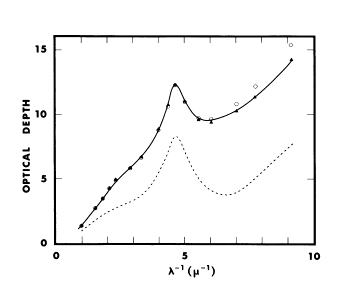
An average absorption curve, the far infrared is on the left and the ultraviolet on the right. There are some variations in different zones of the galaxy, but the shape of the curve is usually quite similar. We can see the peak of absorption are at 200 nm (or 1/lambda = 4.6 ).
Now let's move to the composition of dust. The Sun being so close to Earth is readily observed and we (somehow naively) assume that it is a typical star and its composition is assumed to be fairly typical of the Galaxy. We can then use the Sun abundance of elements as a guide for relative abundances between it and the interstellar medium.
We know that the relative abundances of the Sun and the interstellar medium are different. The main difference is that some elements have an underabundance of elements compared to the Sun. This elements are usually refractory, meaning that this elements can survive high temperatures without being sublimated, this directly points us to dust, as this elements can condense in dust grains that can survive in the vicinity of stars. Depletion is defined as

and as we can see below, this elements are among others Cr, Fe, Ni, Co, Ti. Despite that, the bulk of a grain is quite similar in composition to the dust you can find in your backyard and is mostly divied in to graphites, silicates and olivines.
Interstellar elemental abundances compared relative to hydrogen compared with the Sun. We can see that refractory elements are heavily depleted. The depletion is a logarithmic quantity defined, meaning that some elements like Ti are depleted by three orders of magnitude.
So, how are dust grains formed? The first idea is to think that they grow slowly in the interstellar medium. The problem with this idea is that actual calculations show that this will take too much time, suppose that at time t=0 the grain has a radius r(0), if we suppose the grain grows by addition of species i with mass m_i moving at a mean thermal speed v_i then the radius at a later time t will be

where epsilon is a "sticky coefficient" that meassures the probability that the m_i will remain attached to the grain and s is the density of the solid grain. Using the typical values for interstellar medium we find that for a typical grain (about the size of visible wavelengths) the time required is

which is too much time if we consider that the value of epsilon is smaller than one, and that the age of the universe is around 13 Gyr.
The solution comes from considering denser regions, in particular the atmospheres of cool stars. The material in stars is originally so hot that it did not contain any solids, but as it outflows in later phases of the life of the star it starts to cool with much higher densities than the interstellar medium and the atoms can arrange themselves in to the most stable molecules at that temperature (usually around 10³ K). When this outer layers are ejected in stellar winds the dust goes in to the interstellar medium. There is some controversy about the formation of dust in the early life of the universe, the most accepted view is that this dust was formed around active galactic nuclei.
Now let's move to grains destruction. The simplest way to destroy a grain is to heat it enough so it sublimates. That indeed happens in the vicinities of young, hot stars. The sublimation temperatures depend on the composition and size of the grain, this results in a stratification of the dust with large graphites closer to the star, followed by smaller graphites and large silicates, at larger distances from the star we can find smaller silicates, olivines, fused quartz and silicates with ice mantles.
A more interesting mechanism comes from accumulation of electric charges in the surface of the dust, if the grain is spherical with a radius a and is carrying a charge of Z electrons then the electrons capture cross section if the speed of the electrons is u_e is given by

When enough electric charge accumulates on the surface the stress it causes on the grain as it tries to redistribute, causes the grain to literally explode! Quite an interesting consequence for the well known fact that charges redistributes on a surface!
It actually results that the capture of species by dust grains has a crucial importance in astrobiology, keep tuned!
Monday, December 24, 2007
Merry Christmas
Today it's Christmas eve. Receive the warmest regards from the "staff" of this blog. On this day, 39 years ago the crew of Apollo 8 entered into orbit around Moon, so this is also an special day for space exploration. Not only that, maybe there is a quite special gift under the tree this year: 2007 WD5.
2007 WD5 is an asteroid that will cross Mars orbital path in January 30. There is some chance (around 1 in 75) that it will impact Mars! This asteroid is around 50 meters wide and might create a half-mile wide impact crater. Despite this event is rather unlikely it will cast some serious fireworks in case it happens.
You can read the JPL official press release here.
 This is the orbital path of 2007 WD5, you can clearly see that it intercepts Mars orbit. The uncertainties in the measurement of 2007 WD5 path don't allow us to assure a collision will happen, actually it's quite unlikely it will occur. In a few days we will have more data.
Update: This asteroid has been recently identified in archival imagery, this has allowed astronomers to refine the orbital parameters, now the odds of a collision are of 1 in 25! Still a rather meager chance (4%), but we still need more data for a more accurate prediction.
Monday, December 17, 2007
Dust in the interstellar medium
Today I will give you a brief overview of a topic that's quite close to me: the effects of dust in interstellar medium. There are some regions in the sky that seem to be almost magically depleted of stars, even in very dense regions. The classical example of this "dark nebulae" is the coalsack in the Crux constellation.
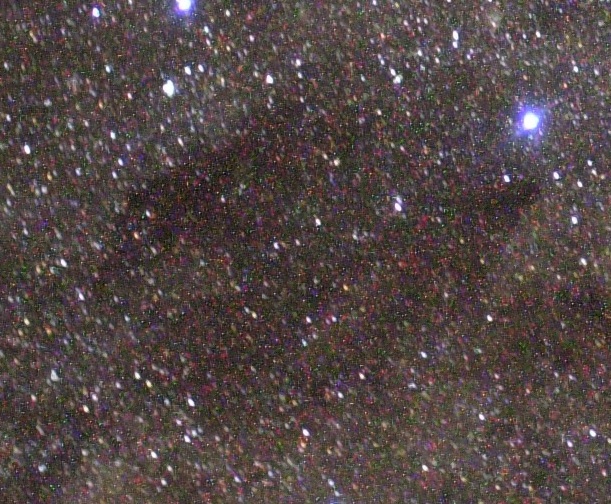 The coalsack dark nebula is the best known region where interstellar dust is so dense that it blocks all the light (in the visible frequencies) in it's sightline.
This regions are not depleted of stars, but rather the light of the stars in the sightline is absorbed by dust. This is far from obvious, after all there is no a priori reason to discard the idea that this regions simply lack any stars.
The first conclusive evidence of light absorption in the interstellar medium came from the work of Robert Trumpler who measured the angular sizes of globular clusters trying to calculate its distance from Earth. The idea was simple, let's assume that globular clusters are roughly the same size, then the smaller a particular cluster seems to us, the farther it is. When Trumpler carried on this plan he realized that the there was a linear relation between the size and the distance, i.e. the clusters were bigger as the distance to them increased. This was quite unexpected and also seemed to point to the rather disturbing conclusion that Earth is located in a special place where globular clusters are smaller.
Rather than that, Trumpler realized that the distance was systematically overestimated (so the clusters weren't that big, after all). Then he assummed that the reason for this bias was extinction in the interstellar medium, meaning that something (presumably dust) was absorbing light on its way to Earth.
Further evidence for dust comes from light polarization. When light is reflected from a dust grain it is polarized depending on the alignement of the grain, if the grains are aligned with Milky Way's magnetic field, we can then use the dust polarization as a measure of the direction of the magnetic field.
 Measurements of dust polarization, this measurements show that optical polarization is aligned with the magnetic field.
What is the composition of this dust? This depends on many factors. Nonetheless the most important one is the distance to a star, particullary to hot, young stars. This stars (known as early spectral type) are so hot that that dust sublimates in its vecinity. The grains composed of carbonites are more resistent (and bigger grains have a better chance of survival), then the silicates enter the stage. In colder enviroments larger molecules appear on the surface of the grains.
How are this grains formed? Why is dust relevant for astrobiology? Which are the effects of dust on ionized regions? Keep tuned for later posts!
The first conclusive evidence of light absorption in the interstellar medium came from the work of Robert Trumpler who measured the angular sizes of globular clusters trying to calculate its distance from Earth. The idea was simple, let's assume that globular clusters are roughly the same size, then the smaller a particular cluster seems to us, the farther it is. When Trumpler carried on this plan he realized that the there was a linear relation between the size and the distance, i.e. the clusters were bigger as the distance to them increased. This was quite unexpected and also seemed to point to the rather disturbing conclusion that Earth is located in a special place where globular clusters are smaller.
Rather than that, Trumpler realized that the distance was systematically overestimated (so the clusters weren't that big, after all). Then he assummed that the reason for this bias was extinction in the interstellar medium, meaning that something (presumably dust) was absorbing light on its way to Earth.
Further evidence for dust comes from light polarization. When light is reflected from a dust grain it is polarized depending on the alignement of the grain, if the grains are aligned with Milky Way's magnetic field, we can then use the dust polarization as a measure of the direction of the magnetic field.
 Measurements of dust polarization, this measurements show that optical polarization is aligned with the magnetic field.
What is the composition of this dust? This depends on many factors. Nonetheless the most important one is the distance to a star, particullary to hot, young stars. This stars (known as early spectral type) are so hot that that dust sublimates in its vecinity. The grains composed of carbonites are more resistent (and bigger grains have a better chance of survival), then the silicates enter the stage. In colder enviroments larger molecules appear on the surface of the grains.
How are this grains formed? Why is dust relevant for astrobiology? Which are the effects of dust on ionized regions? Keep tuned for later posts!
Friday, December 14, 2007
Doomsday
What will happen to the Earth in the far future? Can humanity or it's successors live forever in it? By now most of you know the lore: the sun will eventually consume all of its "fuel" (hydrogen and later helium) in 5 billion years, expand in to a red giant that will devour Mercury, Venus and the Earth. After that the Sun will eject the outers layers of its atmosphere and leave a stellar corpse: a white dwarf which is small, extremely hot object supported by the pressure of electron degeneracy. The ejected outer layers will be ionized by the radiation of the white dwarf and form a nice planetary nebula, like the Helix.

The Helix nebula is one of the best known planetary nebulae, in the astro-lore it is usually asummed that the Sun will produce a similar nebula when it dies.
Well, I recently attended a talk by Klaus Peter-Schroeder, from University of Guanajuato, in his talk he disputed this scenario. Now, let's discuss the good, the bad and the evil ...
Addendum: It results I was being very naive with the raise of temperature. In Klaus own words:
"It is 1 Gyr for a rise of 10% in the solar irradiance, which makes the Earth leave the habitable zone. But in order to raise the temperature by just 10K, we need much less time! It is difficult to compute because a detailed knowledge of the various positive (and negative) feed-backs is required, but it should be of the order of 100 mio years. That is still very long compared to the timescale of the current climate change....! "
- The good: Previous models assumed a "naive" modeling of mass loss as the Sun ejects it's outer layers based on Reimer's Law, which is basically based on dimensional arguments. An improved version of this law applied to the Sun shows that it will loose enough mass to allow Earth's orbit to enlarge sufficiently to avoid the doomsday scenario.
- The bad: Well, that doesn't mean that Earth will be an habitable planet. It will be too uncomfortably close to the Sun, but you might still think that we have around 5 billon years to worry about that. Well, that's wrong. The Sun will increase it's energy output in around a billion years (still a lot of time) by a sufficient amount to increase Earth's temperature around 10 K. You might think that it will be an uncomfortable but still bearable change, nonetheless climate models predict that effects of such a change will be catastrophic.
In "The End of the World", the Doctor travels to Earth's last moments before being engulfed by the Sun. In the show the writers imagined that some "gravity satellites" held back the expansion of the Sun, we now know that it will be tidal dragging to blame for Earth's destruction.
- The evil: Well, life on Earth will end one day, but at least will Earth survive to total destruction? Not really, despite that the Sun won't grow enough to engulf Earth, a process known as tidal dragging (you can think of it as a sort of "tidal friction" assisted by dynamical drag) will cause the Earth to spiral into the Sun! The model is extremely sensitive to little details, but we can estimate that the doomsday will happen just 500 000 years before the Sun reaches the tip of the AGB branch.

Addendum: It results I was being very naive with the raise of temperature. In Klaus own words:
"It is 1 Gyr for a rise of 10% in the solar irradiance, which makes the Earth leave the habitable zone. But in order to raise the temperature by just 10K, we need much less time! It is difficult to compute because a detailed knowledge of the various positive (and negative) feed-backs is required, but it should be of the order of 100 mio years. That is still very long compared to the timescale of the current climate change....! "
Saturday, November 17, 2007
Modest Understanding of Lie Groups Part 0: U(1)
This semester I had the pleasure to take a very little nice course on mathematics, mathematics for physicists that is. What this means is that half the course we dealt with lie groups and the remaining month or so we studied path integrals. Now, why is this interesting? It just happens to be the sexiest mathematics available to me at this point.
In case you didn't know, finding symmetries in physics leads to a deeper understanding of the phenomena at hand. This is obvious to any undergraduate student facing for the first time electromagnetism. The most basic problem of this course is finding the electrical field a distance d above an very long line of uniform density charge. Needless to say, you want to know how much the line would pull (or repel) a charge, should you feel like putting one a distance d above it. Of course you don't need to understand much about physics to eventually see that it doesn't matter where you place it, as long as it is a distance d perpendicular to the cable. Clearly this is because the line of charge is very long and this places are practically the same to the line. From this information you then can guess that the electric field must only depend on the coordinate perpendicular to the line, a trivial conclusion, but proves the point just fine I guess.
Again, why am I talking about this? Turns out our most precious tool (for the moment) allowing us understanding the world, the Standard Model, is based on symmetry groups. Namely it is usually represented by SU(3)xSU(2)xU(1). Let's start by understanding the simplest part of this: U(1). Imagine a circle, or rather, its points:
.jpg) In this figure, A and B are two points on the circle. All the points on this circle are characterized by some properties. For example, if a point on the circle is represented by the vector
In this figure, A and B are two points on the circle. All the points on this circle are characterized by some properties. For example, if a point on the circle is represented by the vector

the point

In case you didn't know, finding symmetries in physics leads to a deeper understanding of the phenomena at hand. This is obvious to any undergraduate student facing for the first time electromagnetism. The most basic problem of this course is finding the electrical field a distance d above an very long line of uniform density charge. Needless to say, you want to know how much the line would pull (or repel) a charge, should you feel like putting one a distance d above it. Of course you don't need to understand much about physics to eventually see that it doesn't matter where you place it, as long as it is a distance d perpendicular to the cable. Clearly this is because the line of charge is very long and this places are practically the same to the line. From this information you then can guess that the electric field must only depend on the coordinate perpendicular to the line, a trivial conclusion, but proves the point just fine I guess.
Again, why am I talking about this? Turns out our most precious tool (for the moment) allowing us understanding the world, the Standard Model, is based on symmetry groups. Namely it is usually represented by SU(3)xSU(2)xU(1). Let's start by understanding the simplest part of this: U(1). Imagine a circle, or rather, its points:
.jpg) In this figure, A and B are two points on the circle. All the points on this circle are characterized by some properties. For example, if a point on the circle is represented by the vector
In this figure, A and B are two points on the circle. All the points on this circle are characterized by some properties. For example, if a point on the circle is represented by the vectoris also on the circle! Having seen this, it's easy to see that the points on a circle with the operation of addition (since each point is characterized by an angle, we can understand it as the sum of their angles) form a group. If we see this circle on the complex plane, a point on the circle can be represented by a complex number

and a rotation about the center of the circle will be given by multiplying this number by the following phase factor

and a rotation about the center of the circle will be given by multiplying this number by the following phase factor
This will take us

that is, another point on the circle (closure). If this is new to you, try and find the identity and inverse elements.
We can see this phase factor as a 1X1 matrix, and call it U. It's clear then that in this case

But in general for bigger matrices

I hope then to have explained how this implies that the complex numbers of norm 1 form a group under the operation of multiplication. This group is the most simple I can think of for now, the U(1) group (unitary matrices of rank 1, which satisfy the last equation).
Tune in next time for a brief explanation on all the other classic groups.
Tune in next time for a brief explanation on all the other classic groups.
Saturday, November 03, 2007
Everyone salute the blogino
Last may Symmetry magazine launched a contest for inventing new particles, and the results are out in the latest edition. One of the particles is so relevant for this humble site that it deserves special mention: the blogino, it's creator Jacobo Konigsberg from Fermilab says about it:
Particles created by non-abelian Blog-Blog interactions. Bloginos typically are produced in a very excited state and with a high degree of spin. Even though all their properties have not yet been determined, it is commonly agreed that they exhibit considerable truthiness. They also have the annoying ability to propagate into extra dimensions, away from the blogosphere, and generate lots of phone calls.

The allmighty blogino, the coolest particle around only behind...
The rockon "discovered" by Ike Hall from Fermilab was, hands down, my favorite particle:
Responsible for such things as face-melting guitar solos, heart-pumping rhythms, screaming vocals, and hair bands. Observation of the rockon over the airwaves has been on the decline since 1995.
Yep, that particle really rocks. It's particullary close to me since rock is what I most like in life!
Subscribe to:
Posts (Atom)