Monday, August 14, 2006
Some astronomical humor
I recently landed up in this page (almost by accident), if you have ever done data reduction then you might want to take a look at it. Despite I have never used AIPS, I am somehow familiar with IRAF and the "paleolithic mysticism" is also there, and yes the "painful blows" described there are mostly true. Happy reading.

Friday, July 28, 2006
A regional view
This certainly won't be new to anyone in the region but is important to summarize Latin America 's position in science and technology, and the results are terrible. In a report done by the Inter-American Development Bank (get the numbers here, also check the report on higher education) the data was hard to believe. As an example the whole region spends $11 billion in research and development, this might sound like an awful lot of money but now consider that a single asian country, South Korea, expends $12 billion, more than all the latin american region!
The reasons for this are difficult to pinpoint, but as far as I can say the whole topic isn't in the political agenda. In the past electoral process the candidates rarely mentioned it, maybe they just expected that inversions will arrive to a country that is unable to create any new product. In this regard Mexico registers the ludicrous amount of 82 patents a year! Argentina registers 62 patents and the regional leader, Brazil, registers 130 patents a year. There are many US universities that register many more patents. Let's compare this numbers with Asia, Japan registered 36 000 patents, South Korea around 3000 and China (that has comparable or higher levels of poverty) registered 300.
The research is sponsored mainly by the state which is a rare situation in the world. In the "communist" China 61% of R&D is paid by the bussiness sector in contrast with the 32% in Latin America. The bussiness sector inversion in R&D of course isn't the result of some philantropic ideology but the result of effective state policies, as an example many american universities get money for research from donations that many companies do in exchange of fiscal privileges. But don't expect that transnational companies will put their money in countries with high taxes, inefficient spending, legal uncertainty (remember Evo Morales seize of refineries and oil extraction plants or the seizure of bank deposits in Argentina in 2001).
Even more important, Latin America lacks the necessary human resources to attract R&D inversions that usually go to places like India or Singapur. Take the microprocessors company Intel as an example, most of the region's countries were shocked when Intel decided to move its inversions to Costa Rica (where president Arias removed the army and used those resources for education) instead of the obvious candidates: Mexico, Brazil and Argentina. Even further in the past Intel had looked at the region for a big R&D plant but eventually decided to do it in Haifa, Israel (which is now under fire, literally). In this regard the educative levels are pathetic, in the PISA mathematics test the average score of mexican students was 385, the american students scored 483 and japanese students 534.
Which are the results of this lag in science, research and education? The results are that the region is the slowest-growing one in the development world, while Latin America is projected to grow by 3.7 percent in 2007, sub-Saharan Africa will grow by 5.4 percent, the Middle East and North Africa by 5.1 percent, South Asia by 6.2 percent, East Asia by 8.1 percent and Eastern Europe by 5.1 percent. It is imperative for the region to understand that the current situation is untenable: the oil prices won't be sky-high forever and the agricultural and metal export prices increase will certainly decrease in future.
In a region where its leaders speak about the recent export bonanza as the product of their economic wisdom, the future might be gray when the bonanza bubble bursts unless the correct measures are seized. Certainly science, research and education should be the prioritary model for the region's growth and as Ireland and Asiatic example shows, it works.
The reasons for this are difficult to pinpoint, but as far as I can say the whole topic isn't in the political agenda. In the past electoral process the candidates rarely mentioned it, maybe they just expected that inversions will arrive to a country that is unable to create any new product. In this regard Mexico registers the ludicrous amount of 82 patents a year! Argentina registers 62 patents and the regional leader, Brazil, registers 130 patents a year. There are many US universities that register many more patents. Let's compare this numbers with Asia, Japan registered 36 000 patents, South Korea around 3000 and China (that has comparable or higher levels of poverty) registered 300.
The research is sponsored mainly by the state which is a rare situation in the world. In the "communist" China 61% of R&D is paid by the bussiness sector in contrast with the 32% in Latin America. The bussiness sector inversion in R&D of course isn't the result of some philantropic ideology but the result of effective state policies, as an example many american universities get money for research from donations that many companies do in exchange of fiscal privileges. But don't expect that transnational companies will put their money in countries with high taxes, inefficient spending, legal uncertainty (remember Evo Morales seize of refineries and oil extraction plants or the seizure of bank deposits in Argentina in 2001).
Even more important, Latin America lacks the necessary human resources to attract R&D inversions that usually go to places like India or Singapur. Take the microprocessors company Intel as an example, most of the region's countries were shocked when Intel decided to move its inversions to Costa Rica (where president Arias removed the army and used those resources for education) instead of the obvious candidates: Mexico, Brazil and Argentina. Even further in the past Intel had looked at the region for a big R&D plant but eventually decided to do it in Haifa, Israel (which is now under fire, literally). In this regard the educative levels are pathetic, in the PISA mathematics test the average score of mexican students was 385, the american students scored 483 and japanese students 534.
Which are the results of this lag in science, research and education? The results are that the region is the slowest-growing one in the development world, while Latin America is projected to grow by 3.7 percent in 2007, sub-Saharan Africa will grow by 5.4 percent, the Middle East and North Africa by 5.1 percent, South Asia by 6.2 percent, East Asia by 8.1 percent and Eastern Europe by 5.1 percent. It is imperative for the region to understand that the current situation is untenable: the oil prices won't be sky-high forever and the agricultural and metal export prices increase will certainly decrease in future.
In a region where its leaders speak about the recent export bonanza as the product of their economic wisdom, the future might be gray when the bonanza bubble bursts unless the correct measures are seized. Certainly science, research and education should be the prioritary model for the region's growth and as Ireland and Asiatic example shows, it works.
Thursday, July 13, 2006
Blasting out black holes from the galactic disk
A recent paper (1) shows that the black hole X-ray binary XTE J1118+480 might be an ejected black hole from the galactic disk. This system consists in a small star orbiting a black hole, it was discovered in the year 2000 and it was since then an interesting object because of its location in the metal poor galactic halo.
Using the 10 m Keck telescope the spectra of the small star has been observed and surprisingly enough it was very rich in metals (remember that in astronomy anything else from hidrogen and helium is considered as metal, this is because this elements are synthetized inside the cores of stars, elements heavier than iron are believed to form in supernova explosions) suggesting it might actually be a double star from the galactic disk (where the metal abundance is much higher than in the halo), when the massive star in the system went supernova it might caused an asymmetrical blast (by the so called "acoustic mechanism") that expelled the system from the galactuc disk (2).
After reading the paper it seems to me that the metallicity is way too high, it's even higher than the Sun, this means that
Because the estimated age of the small star is around 5 Gyr, so the first scenario is very likely and certainly (almost) discards the origin of this system inside a globular cluster.
Using the 10 m Keck telescope the spectra of the small star has been observed and surprisingly enough it was very rich in metals (remember that in astronomy anything else from hidrogen and helium is considered as metal, this is because this elements are synthetized inside the cores of stars, elements heavier than iron are believed to form in supernova explosions) suggesting it might actually be a double star from the galactic disk (where the metal abundance is much higher than in the halo), when the massive star in the system went supernova it might caused an asymmetrical blast (by the so called "acoustic mechanism") that expelled the system from the galactuc disk (2).
After reading the paper it seems to me that the metallicity is way too high, it's even higher than the Sun, this means that
- This is a relatively recent event so the star is from a later generation than the Sun, so it formed from a mollecular cloud with a higher metal abundance.
- As I mentioned before some of this heavy elements are formed in supernova explosions, making the assymetric natal kick not so necesary, after all.
Because the estimated age of the small star is around 5 Gyr, so the first scenario is very likely and certainly (almost) discards the origin of this system inside a globular cluster.
Saturday, July 08, 2006
EurekaUK
There is a recent report from UK universities about the most remarkable discoveries done in UK universities, in a previous post I had done a similar thing for the mexican case.
Despite some points in which I disagree, like the claim of the contraceptives which were first sintetized in 1951 by Luis Miramontes in Mexico who was aware of the contraceptive use of norethindrone (the work in 1961 by Herchel Smith produced cheaper contraceptive pills which is of course a significant advance, but it seems clear that the report try to sell the idea that contraceptive pills are an UK invention which is false), and also the CFC stuff where the really important role was played by Crutzen, Molina and Rowland (again the work of James Lovelock was an important precedent, but it seems to me they are trying to oversell it), this kind of reports are really important because many countries are facing serious problems with research budgets.
In the case of Mexico the situation is of near disaster with only 0.34% of the gross domestic product going to research despite some countries invest more of the 10%. This situation has only resulted in that most of the inversions in technology have gone to Asia where the situations is radically diferent, let's see how the new president faces this challenge.
Despite some points in which I disagree, like the claim of the contraceptives which were first sintetized in 1951 by Luis Miramontes in Mexico who was aware of the contraceptive use of norethindrone (the work in 1961 by Herchel Smith produced cheaper contraceptive pills which is of course a significant advance, but it seems clear that the report try to sell the idea that contraceptive pills are an UK invention which is false), and also the CFC stuff where the really important role was played by Crutzen, Molina and Rowland (again the work of James Lovelock was an important precedent, but it seems to me they are trying to oversell it), this kind of reports are really important because many countries are facing serious problems with research budgets.
In the case of Mexico the situation is of near disaster with only 0.34% of the gross domestic product going to research despite some countries invest more of the 10%. This situation has only resulted in that most of the inversions in technology have gone to Asia where the situations is radically diferent, let's see how the new president faces this challenge.
Wednesday, July 05, 2006
No the best possible outcome
We still don't have an official result of the elections, the cause is simple: Andres Manuel Lopez Obrador has acussed everyone of massive fraud, including the loss of 3 million votes (the votes were indeed in the Prelimary Results Program, so this was completely disproved) and has threatned threatened with massive protests and said: "The stability of the country is at stake" (1). The prelimary results with 98.5 of the votes counted showed that PAN won by around 1% (around 400 000 votes), after counting the 3 million votes that are hold the PAN still wins by 0.6% (250 000 votes). With such a close election, has said Andres Manuel Lopez Obrador "The political stability of the country hangs in the balance." and it seems clear he simply won't accept his defeat soon.
This photo actually portraits very well my impressions of this protests, the placard says "fraud" next to the the latest elections since 1988 (actually the election of 1988 is widely regarded as fraudulent, and even one of the candidates died on suspicious circunstances after the election), despite since 1994 the IFE has organized the elections and all of them had been considered as valid by international organizations. The top of the placard acusses of the fraud the PAN, PRI (their principal competitors) and TV Azteca (this is completely ridiculous, despite it dubious antecedents I don't see how this TV network can alter the ballot boxes). I won't even comment about the URSS flag...
 This is one of the worst scenarios, the PRD won't accept its defeat, and the stocks have already lost 4.3%. The IFE has decidied to recount every vote tallie.
As of 8:59 PM the results are PRD: 36.45 and PAN:34.83 but many districts in which PAN had most of the votes aren't counted yet. Wait, now at 9:15 are rumors the count has halted!!!
Update: The rumor was simply false and the stocks have been stable recently, this recount has actually showed the same results: in the preliminary results Calderón won by 0.6%, in the recount he won by 0.57%. Obrador has impugned the election and has treatened with more protests, has acussed the IFE of being a corrupt and fraudulent institution, called Vicente Fox a traitor to the country and even acussed his own representants of selling out. This will only affect his own political future, personally I just want him to shut up.
This photo actually portraits very well my impressions of this protests, the placard says "fraud" next to the the latest elections since 1988 (actually the election of 1988 is widely regarded as fraudulent, and even one of the candidates died on suspicious circunstances after the election), despite since 1994 the IFE has organized the elections and all of them had been considered as valid by international organizations. The top of the placard acusses of the fraud the PAN, PRI (their principal competitors) and TV Azteca (this is completely ridiculous, despite it dubious antecedents I don't see how this TV network can alter the ballot boxes). I won't even comment about the URSS flag...
 This is one of the worst scenarios, the PRD won't accept its defeat, and the stocks have already lost 4.3%. The IFE has decidied to recount every vote tallie.
As of 8:59 PM the results are PRD: 36.45 and PAN:34.83 but many districts in which PAN had most of the votes aren't counted yet. Wait, now at 9:15 are rumors the count has halted!!!
Update: The rumor was simply false and the stocks have been stable recently, this recount has actually showed the same results: in the preliminary results Calderón won by 0.6%, in the recount he won by 0.57%. Obrador has impugned the election and has treatened with more protests, has acussed the IFE of being a corrupt and fraudulent institution, called Vicente Fox a traitor to the country and even acussed his own representants of selling out. This will only affect his own political future, personally I just want him to shut up.
Monday, July 03, 2006
Not yet...
We still don't have an official winner of the election, the election is simply too close for call and the results will be announced until wednesday. It seems that Felipe Calderon has won but we only have 9% of the votes counted, in the election for legislators exit polls show that PAN has 35% of the votes and PRD a 31%.
Despite who turns out to be the next president, the PRI which ruled for more than 70 years before Vicente Fox has now falled to the third place! I don't have any idea if the PRI is prepared for this. The other source of concern regards Andres Manuel Lopez Obrador who has hinted won't accept a defeat by a close margin, there are some concerns about movilizations, but let's wait until wednesday for that.
Despite who turns out to be the next president, the PRI which ruled for more than 70 years before Vicente Fox has now falled to the third place! I don't have any idea if the PRI is prepared for this. The other source of concern regards Andres Manuel Lopez Obrador who has hinted won't accept a defeat by a close margin, there are some concerns about movilizations, but let's wait until wednesday for that.
Sunday, July 02, 2006
Elections day
Today we have elections for president and in some states (including Jalisco, where I live) we also have governor elections.
Amazingly enough, Mexico city has what I perceive as two rather good candidates: Demetrio Sodi and Beatriz Paredes, the amazing part is not only having decent candidates, but that the exit polls show that Marcelo Ebrard who was sacked by Vicente Fox after Ebrard refused to help three federal police officers who were lynched in Tlahuac is winning with 52% of the votes! During the hours long incident which ended in the death of two of them and included officers' pleas for help in national TV, authorities refused to send any kind of reinforcements, later videos showed that Ebrard was aware of the situation but refused to act because he was in a precampaign act. He also famous for wasting millions of dollars for Giuliani's services that didn't improve the security in Mexico city at all. The only reason I find for this is that PRD has been able to emulate the structure of PRI the party that ruled Mexico for more than 70 years, after all most of the people surrounding Ebrard and Obrador are well known members of Carlos Salinas de Gortari cabinet.
Andres Manuel López Obrador was Mexico City's mayor at the time of the incident and said that he would never use the public force, even in extreme situations as lynchings, he also mocked of the million of participants in march demanding the end of the recent insecurity wave, when months later were released TV ads showing victims of kidnappings and encounters with criminals he said he was the"victim of a complot". A few months before members of his cabinet were videotaped receiving millionare bribes from Carlos Ahumada and Carlos Ponce (the minister of finances) was videotaped gambling huge amounts of money in Las Vegas, a few days ago Ahumada's wife threatened to show more videos involving more López Obrador collaborators, and later suffered an attempt on her life, this videos are now believed to be lost. He is now the leading candidate for the presidency, don't even try to ask me why.
In the local election for governor Emilio González Marquez seems to be the winner of the elections, at least from exit polls that show he has 46% of the votes. The campaign for local elections was pathetic, even worse than the federal one and just consisted in a trade of insults and acussations, including acussations of narcotrafic, corruption and homesexuality. Of course this only results in most people view of politcs as the less honorable job in the world.
Law prohibits the release of any kind of result regarding the federal election before 9 PM in local media, I don't know if this blog is considered as a local media, but I will remain on the safe side. Maybe some international media releases some information, surely a web search can help in that regard.
Amazingly enough, Mexico city has what I perceive as two rather good candidates: Demetrio Sodi and Beatriz Paredes, the amazing part is not only having decent candidates, but that the exit polls show that Marcelo Ebrard who was sacked by Vicente Fox after Ebrard refused to help three federal police officers who were lynched in Tlahuac is winning with 52% of the votes! During the hours long incident which ended in the death of two of them and included officers' pleas for help in national TV, authorities refused to send any kind of reinforcements, later videos showed that Ebrard was aware of the situation but refused to act because he was in a precampaign act. He also famous for wasting millions of dollars for Giuliani's services that didn't improve the security in Mexico city at all. The only reason I find for this is that PRD has been able to emulate the structure of PRI the party that ruled Mexico for more than 70 years, after all most of the people surrounding Ebrard and Obrador are well known members of Carlos Salinas de Gortari cabinet.
Andres Manuel López Obrador was Mexico City's mayor at the time of the incident and said that he would never use the public force, even in extreme situations as lynchings, he also mocked of the million of participants in march demanding the end of the recent insecurity wave, when months later were released TV ads showing victims of kidnappings and encounters with criminals he said he was the"victim of a complot". A few months before members of his cabinet were videotaped receiving millionare bribes from Carlos Ahumada and Carlos Ponce (the minister of finances) was videotaped gambling huge amounts of money in Las Vegas, a few days ago Ahumada's wife threatened to show more videos involving more López Obrador collaborators, and later suffered an attempt on her life, this videos are now believed to be lost. He is now the leading candidate for the presidency, don't even try to ask me why.
In the local election for governor Emilio González Marquez seems to be the winner of the elections, at least from exit polls that show he has 46% of the votes. The campaign for local elections was pathetic, even worse than the federal one and just consisted in a trade of insults and acussations, including acussations of narcotrafic, corruption and homesexuality. Of course this only results in most people view of politcs as the less honorable job in the world.
Law prohibits the release of any kind of result regarding the federal election before 9 PM in local media, I don't know if this blog is considered as a local media, but I will remain on the safe side. Maybe some international media releases some information, surely a web search can help in that regard.
Saturday, July 01, 2006
Still alive
After a brief hiatus I'm back to action. Actually it seems a lot of things happened recently including a failure of Hubble's main camera, an expresident got a warrant order, and, of course, the World Cup (Mexico lost against Argentina...), and I still can't believe what happened to Denice Denton. Meanwhile I have been deciding where to go for vacations, a small town in Austria seems quite interesting...
Tuesday, June 13, 2006
Weird ideas
I attended yesterday some presentations on diverse topics of current research. This sessions were intended for the students of an introductory course in modern physics and I presented a little talk about baryogenesis, you can get it here (in spanish), as the course didn't cover cosmology in its (large) list of topics I actually spent a large fraction of the talk in some elementary concepts like the Friedmann equation and the critical density.
One of the talks was actually very intersting for many reasons, it was a 6d extension of the old Kaluza-Klein theory that was worked by a local faculty member some years ago when he was at Moscow State University. The intersting stuff is that he claimed that the model could reproduce the Glashow-Salam-Weinberg theory of electroweak interactions, unfortunately the talk was pressented by a student that was unable to give absolutely any detail of how they arrived at that conclusion (I have requested the original author a copy of the article, I'll post it when I have it), but the most interesting result was that they derived that some constants were changing in time (this is not a really new idea) and among the changing constants was e, the unit of electric charge.
Although it would be an amazing discovery this simply looks wrong, changing the value of e over time would change the fine structure constant (α ≡ e^2/h bar c ≈ 1/137). However there have been many attempts to check if α is constant and any of them have found nothing, you can look at a recent one here (the published article is here). Look at Sean Carroll's entry on changing constants (in his case it is the ratio between the mases of the proton and electron) here.
At the end of my talk I was bombarded by questions that sounded to me like the stationary universe: the idea that the universe looks the same in time, this needs some matter creation mechanism (otherwise the density would change in time). I actually went to explain that practically anyone in the astrophysical community believes in this kind of theories, that CBR really looks like blackbody radiation and it lacks the polarization one would expect if CBR is light from ancient stars which has been scattered by galactic dust (the usual explantion of CBR in steady state theories), and that we have a really big body of evidence that suggests that indeed the density is changing some members of the audience still seemed to prefer to just ignore the bulk of experimental evidence.
I don't want to state a debate here (there are so many intersting debates at Peter Woit's blog "Not even wrong"), but it really concerns me that a (rather small, to be honest) fraction of the theoretical community is so distanced from the experiments.
One of the talks was actually very intersting for many reasons, it was a 6d extension of the old Kaluza-Klein theory that was worked by a local faculty member some years ago when he was at Moscow State University. The intersting stuff is that he claimed that the model could reproduce the Glashow-Salam-Weinberg theory of electroweak interactions, unfortunately the talk was pressented by a student that was unable to give absolutely any detail of how they arrived at that conclusion (I have requested the original author a copy of the article, I'll post it when I have it), but the most interesting result was that they derived that some constants were changing in time (this is not a really new idea) and among the changing constants was e, the unit of electric charge.
Although it would be an amazing discovery this simply looks wrong, changing the value of e over time would change the fine structure constant (α ≡ e^2/h bar c ≈ 1/137). However there have been many attempts to check if α is constant and any of them have found nothing, you can look at a recent one here (the published article is here). Look at Sean Carroll's entry on changing constants (in his case it is the ratio between the mases of the proton and electron) here.
At the end of my talk I was bombarded by questions that sounded to me like the stationary universe: the idea that the universe looks the same in time, this needs some matter creation mechanism (otherwise the density would change in time). I actually went to explain that practically anyone in the astrophysical community believes in this kind of theories, that CBR really looks like blackbody radiation and it lacks the polarization one would expect if CBR is light from ancient stars which has been scattered by galactic dust (the usual explantion of CBR in steady state theories), and that we have a really big body of evidence that suggests that indeed the density is changing some members of the audience still seemed to prefer to just ignore the bulk of experimental evidence.
I don't want to state a debate here (there are so many intersting debates at Peter Woit's blog "Not even wrong"), but it really concerns me that a (rather small, to be honest) fraction of the theoretical community is so distanced from the experiments.
Thursday, June 01, 2006
New Ubuntu release
The latest version of the popular linux distribution Ubuntu has been released today. I don't really find necessary to post a review here because there are many excellent reviews in Distrowatch, but if you need some scientific software running in linux keep reading.
In observational astronomy the most important software package is undoubtly IRAF, you can get it very easily following this instructions, the other famous astronomy package is the now dead Starlink, the debian version of it runs nicely in Ubuntu.
Adding additional repositories will allow you to install lots of scientific apps easily using synaptic, among them are the numerical libraries gsl and scipy, the matlab clone GNU Octave, fortran compilers, latex editors like Lyx and Kile, computer algebra systems like maxima and yacas, the TexMacs interface, the fast numerical app yorick, R, Cernlib, plotting sotware like GNUplot and kst, QCad and many other apps.
In observational astronomy the most important software package is undoubtly IRAF, you can get it very easily following this instructions, the other famous astronomy package is the now dead Starlink, the debian version of it runs nicely in Ubuntu.
Adding additional repositories will allow you to install lots of scientific apps easily using synaptic, among them are the numerical libraries gsl and scipy, the matlab clone GNU Octave, fortran compilers, latex editors like Lyx and Kile, computer algebra systems like maxima and yacas, the TexMacs interface, the fast numerical app yorick, R, Cernlib, plotting sotware like GNUplot and kst, QCad and many other apps.
Saturday, May 27, 2006
Units
In a recent post in Cosmic Variance, Sean Carroll recalls his personal experiences when talking about the metric system in the US, one of only 3 countries that have not officially adopted the SI system. What really amazes me is that even in physics we have some remarkably poor decisions about units, the usual decision to measure E (the electric field) and B (the magnetic field) in different units seems to me ridiculous and is a common point of confusion among begginers (so E and B compose the electromagnetic field but each one has different units?), probably the reason for this is that the mks are much more popular in engineering but I still insist that cgs units avoid obscuring the structure of the theory. I also dislike some modern physics textbooks that in the chapter devoted special relativity never get to writing time as ct, for a nice discussion of this (and other topics in SR) look at the classic book Spacetime Physics by Taylor and Wheeler.
On practical issues it just seems that not adopting an almost worldwide systems of units is more of a hassle than just adopting it, specially because many units are similar (the meter is just a bit larger than a yard and a pound is almost half kilogram). There have been some remarkable incidents in this regard that are noteworthy: In 1983 a Boeing 767 jet ran out of fuel at 12 000 m (40,000 feet) with 61 passengers aboard, this was caused by a units issue, this is the origin of the Gimli Glider expression in western Canada which means making a spectacular foul-up, also the US$ 125 million Mars Climate Orbiter was destroyed by a metric mixup.
Finally, there is article about this metrification issue in Wikipedia where you can read the different approaches to this problem in many countries, probably US can follow the example of Ireland in this regard. Look at the map showing the countries that use the metric system, only the black ones don't use it.

On practical issues it just seems that not adopting an almost worldwide systems of units is more of a hassle than just adopting it, specially because many units are similar (the meter is just a bit larger than a yard and a pound is almost half kilogram). There have been some remarkable incidents in this regard that are noteworthy: In 1983 a Boeing 767 jet ran out of fuel at 12 000 m (40,000 feet) with 61 passengers aboard, this was caused by a units issue, this is the origin of the Gimli Glider expression in western Canada which means making a spectacular foul-up, also the US$ 125 million Mars Climate Orbiter was destroyed by a metric mixup.
Finally, there is article about this metrification issue in Wikipedia where you can read the different approaches to this problem in many countries, probably US can follow the example of Ireland in this regard. Look at the map showing the countries that use the metric system, only the black ones don't use it.

Thursday, May 25, 2006
Happy Towel Day !!!

Today is Towel Day! If you have read Douglas Adams' book The Hitchhiker's Guide to the Galaxy you can remember that a towel is the most useful object around:
"The Hitchhiker's Guide to the Galaxy has a few things to say on the subject of towels. A towel, it says, is about the most massively useful thing an interstellar hitchhiker can have. Partly it has great practical value—you can wrap it around you for warmth as you bound across the cold moons of Jaglan Beta; you can lie on it on the brilliant marble-sanded beaches of Santraginus V, inhaling the heady sea vapours; you can sleep under it beneath the stars which shine so redly on the desert world of Kakrafoon; use it to sail a mini raft down the slow heavy river Moth; wet it for use in hand-to-hand combat; wrap it round your head to ward off noxious fumes or to avoid the gaze of the Ravenous Bugblatter Beast of Traal (a mindboggingly stupid animal, it assumes that if you can't see it, it can't see you—daft as a brush, but very, very ravenous); you can wave your towel in emergencies as a distress signal, and of course dry yourself off with it if it still seems to be clean enough. More importantly, a towel has immense psychological value. For some reason, if a strag [non-hitch hiker] discovers that a hitchhiker has his towel with him, he will automatically assume that he is also in possession of a toothbrush, face flannel, soap, tin of biscuits, flask, compass, map, ball of string, gnat spray, wet weather gear, space suit etc., etc. Furthermore, the strag will then happily lend the hitchhiker any of these or a dozen other items that the hitchhiker might accidentally have 'lost'. What the strag will think is that any man who can hitch the length and breadth of the galaxy, rough it, slum it, struggle against terrible odds, win through, and still knows where his towel is, is clearly a man to be reckoned with." (The Hitchhiker's Guide to the Galaxy, Chapter Three).
I actually forgot the towel in the morning just to be reminded of the importance of the day by classmates... ohh well, I hope you enjoy this day.
Saturday, May 20, 2006
Urban legends
We have all heard this urban legend: A student arrives late to a class (or test) and tries to solve a particullary difficult problem posed in the blackboard which later turns to be an unsolved problem. Well this story is true and has happened (as far as I know) at least two times.
The first story regards George Bernard Dantzig, famous for the simplex algorithm and also one of the founders of linear programming. Here are Dantzig's own words:
During my first year at Berkeley I arrived late one day to one of Neyman's classes. On the blackboard were two problems which I assumed had been assigned for homework. I copied them down. A few days later I apologized to Neyman for taking so long to do the homework - the problems seemed to be a little harder to do than usual. I asked him if he still wanted the work. He told me to throw it on his desk. I did so reluctantly because his desk was covered with such a heap of papers that I feared my homework would be lost there forever.
About six weeks later, one Sunday morning about eight o'clock, Anne and I were awakened by someone banging on our front door. It was Neyman. He rushed in with papers in hand, all excited: "I've just written an introduction to one of your papers. Read it so I can send it out right away for publication." For a minute I had no idea what he was talking about. To make a long story short, the problems on the blackboard which I had solved thinking they were homework were in fact two famous unsolved problems in statistics. That was the first inkling I had that there was anything special about them.
To be honest I don't really know which theorems are the ones mentioned in this story, but I found a paper of that time (1940) that should be the one mentioned in the story:
The second story regards a very nice theorem in differential geometry that I know well: the Fary-Milnor Theorem. The legend says that John Milnor (a classmate of the famous John Nash), was sleeping in class while the proffesor explained three unsolved problems in knot theory and when he woke up he copied from the blackboard the three problems (which he assumed were assigned as homework). A week later he turned in solutions for every problem!!! Among these problems was the Fary-Milnor theorem. This gives me an opportunity to discuss this nice theorem.
The curvature K (which should be the greek letter kappa) is a function with real values over some set C (which denotes a parametrization by arc length). This theorem says that if we calculate the total curvature (by doing the integration in the trajectory) then:
 if the parametrized curve C don't have any knots, this means that C can be deformed in to a circumference without been teared. Of course if C has knots then
 Actually the total curvature is always bigger or equal than 2*pi and only equals 2*pi if C represents a circumference, just as we should expect. The formal statement of this result is the Fary-Milnor theorem.
John Milnor would later receive the Fields Medal for his proof that a 7-dimensional sphere can have several differential structures (28 to be exact), this result opened the field of differential topology
The first story regards George Bernard Dantzig, famous for the simplex algorithm and also one of the founders of linear programming. Here are Dantzig's own words:
During my first year at Berkeley I arrived late one day to one of Neyman's classes. On the blackboard were two problems which I assumed had been assigned for homework. I copied them down. A few days later I apologized to Neyman for taking so long to do the homework - the problems seemed to be a little harder to do than usual. I asked him if he still wanted the work. He told me to throw it on his desk. I did so reluctantly because his desk was covered with such a heap of papers that I feared my homework would be lost there forever.
About six weeks later, one Sunday morning about eight o'clock, Anne and I were awakened by someone banging on our front door. It was Neyman. He rushed in with papers in hand, all excited: "I've just written an introduction to one of your papers. Read it so I can send it out right away for publication." For a minute I had no idea what he was talking about. To make a long story short, the problems on the blackboard which I had solved thinking they were homework were in fact two famous unsolved problems in statistics. That was the first inkling I had that there was anything special about them.
To be honest I don't really know which theorems are the ones mentioned in this story, but I found a paper of that time (1940) that should be the one mentioned in the story:
- G. B. Dantzig 1940. On the non-existence of tests of "Student's" hypothesis having power functions independent of σ, Annals of Mathematical Statistics, Volume 11, number 2, pp186-192
The second story regards a very nice theorem in differential geometry that I know well: the Fary-Milnor Theorem. The legend says that John Milnor (a classmate of the famous John Nash), was sleeping in class while the proffesor explained three unsolved problems in knot theory and when he woke up he copied from the blackboard the three problems (which he assumed were assigned as homework). A week later he turned in solutions for every problem!!! Among these problems was the Fary-Milnor theorem. This gives me an opportunity to discuss this nice theorem.
The curvature K (which should be the greek letter kappa) is a function with real values over some set C (which denotes a parametrization by arc length). This theorem says that if we calculate the total curvature (by doing the integration in the trajectory) then:
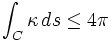 if the parametrized curve C don't have any knots, this means that C can be deformed in to a circumference without been teared. Of course if C has knots then
 Actually the total curvature is always bigger or equal than 2*pi and only equals 2*pi if C represents a circumference, just as we should expect. The formal statement of this result is the Fary-Milnor theorem.
John Milnor would later receive the Fields Medal for his proof that a 7-dimensional sphere can have several differential structures (28 to be exact), this result opened the field of differential topology
Saturday, May 13, 2006
Science In Mexico
I have been trying to write an entry about science awareness in the country but for some reason I have not been able to finish it. One of the points I try to emphasize is that despite most people knows the quacks like Jaime Maussan or Carlos Trejo (the first one is known worldwide for a series of ufo related scams, and the former claims to have detected ghosts making him a clear candidate to join the faculty of a new degree offered by Coventry University), few of them can name a mexican scientist and the general idea of the people here is that Mexico hasn't made any contribution to science.
My humble contribution to remedy this consists in offering you the following facts about science done by mexican scientists:
My humble contribution to remedy this consists in offering you the following facts about science done by mexican scientists:
- Vanadium was discovered in Mexico by Andrés Manuel del Río.
- The first oral contraceptive (norethindrone) was invented in Mexico by Luis E. Miramontes, Carl Djerassi and George Rosenkranz of the mexicam company Syntex. In 2004, the invention of Luis E. Miramontes was chosen as the twentieth most important one of all the times. The election was organized by SCENTA, an initiative of The Engineering and Technology Board of the United Kingdom.
- Mario Molina (Nobel Prize in Chemistry, 1995) discovered the role of CFCs in the depletion of the ozone layer.
- Guillermo Haro discovered the Herbig-Haro objects, he and his coworkers discovered flare stars, paving the way for the theory of star formation. The three color technique for Schmidt plates developed in Tonantzintla turned to be crucial in the detection of quasars. The work of Guillermo Haro and colleagues paved the way for making astronomy the strongest science in Mexico.
- Microquasars were discovered by Luis Félipe Rodríguez in collaboration with the argentinian astronomer Félix Mirabel.
- The famous Alcubierre warp drive a theoretical (don't expect any faster than light ship to be constructed) mechanism of superluminal speed is the work of Miguel Alcubierre.
- Marcos Moshinsky's work (the transformation parenthesis for functions of harmonic oscillation) was fundamental to the study of nuclear structures.
- The theory (and observations) of star formation has received crucial contributions by mexican astronomers like Jorge Cantó, Susana Lizano and Arcadio Poveda.
- Carlos Frenk (the second most cited scientist in Europe) is mexican and has made crucial contributions to cosmology, particullary in the issue of structure formation
- Guillermo Gonzalez Camerena patented the mechanism for the first color TV (consider the number of hours you have enjoyed this invention).
- Manuel Sandoval Vallarta pioneered the efforts to understand cosmic rays, showing clearly that the rays were composed by charged particles (and not gamma rays as tought at that time) attracted by the Earth's magnetic field (this is known as the Lemaître-Vallarta theory). An experimental group in Mexico city lead by Luis W. Alvarez carried a series of experiments proposed by Vallarta, showing that cosmic rays are mostly composed by protons and showed the east-west effect.
- Antonio Lazcano, the author of the best-seller The Origin of Life is a world leader on the study of the emergence of life and one of the pioneers of astrobiology.
- Do you know that Jacob Bekenstein (the first to suggest the entropy of black holes) is mexican?
Thursday, May 11, 2006
Trends
I have been playing with the latest gadget from google labs: Google Trends. It seems it appeared last year but it wasn't avalaible to general public until now.
Some of the results are amazing, in science the trends by region are clearly dominated by Asia showing clearly the importance of science in that region. Now let's look at the cities, for the term astrophysics, the searches are concentrated in: Pasadena (home of Caltech), Oxford (UK), Cambridge (UK), Bangalore, Cambridge (USA, home of Harvard and MIT), New Delhi, Mumbai, Chennai and Delhi, all of them in India.
In particle physics Oxford (UK) and Geneva (home of CERN, the biggest particle physics laboratory in the world) clearly dominate the scene with Cambridge(USA) in a distant third place. I couldn't resist to compare the trends in astrophysics and particle physics, and the results show that astrophysics is a bit more popular, but there is a peak in particle physics around mid 2004 when it surpassed astrophysics, I don't know the reason for sure, I speculate it is related to the results of the RHIC.
PD: If you live in Mexico you should find this trends quite interesting. The reason that the red line (the one corresponding to the PRI) don't appears is that the term do not have enough search volume to show graphs! You can even follow the trends of the leading candidates to presidency, the results are fascinating, you can see how the popularity of Andres Manuel Lopez Obrador was unbelievably high during the impeachment process but currently he is way below Felipe Calderon, you can even see how Felipe Calderon was completely unknown before 2005 then matched the popularity of Roberto Madrazo and is now in the lead (at least in terms of web presence).
Some of the results are amazing, in science the trends by region are clearly dominated by Asia showing clearly the importance of science in that region. Now let's look at the cities, for the term astrophysics, the searches are concentrated in: Pasadena (home of Caltech), Oxford (UK), Cambridge (UK), Bangalore, Cambridge (USA, home of Harvard and MIT), New Delhi, Mumbai, Chennai and Delhi, all of them in India.
In particle physics Oxford (UK) and Geneva (home of CERN, the biggest particle physics laboratory in the world) clearly dominate the scene with Cambridge(USA) in a distant third place. I couldn't resist to compare the trends in astrophysics and particle physics, and the results show that astrophysics is a bit more popular, but there is a peak in particle physics around mid 2004 when it surpassed astrophysics, I don't know the reason for sure, I speculate it is related to the results of the RHIC.
PD: If you live in Mexico you should find this trends quite interesting. The reason that the red line (the one corresponding to the PRI) don't appears is that the term do not have enough search volume to show graphs! You can even follow the trends of the leading candidates to presidency, the results are fascinating, you can see how the popularity of Andres Manuel Lopez Obrador was unbelievably high during the impeachment process but currently he is way below Felipe Calderon, you can even see how Felipe Calderon was completely unknown before 2005 then matched the popularity of Roberto Madrazo and is now in the lead (at least in terms of web presence).
Tuesday, May 09, 2006
Monday, May 08, 2006
Can we test M Theory in the LHC?
A few years ago if you told someone that higher dimensions could be detected with current technology they would certainly look you as a crackpot. The idea of additional dimensions is older than you might think, it actually goes back to the work of Kaluza and Klein (in the 1920's,) who discovered that if we introduce and additional spacial dimension curled in a really small radius to general relativity the resulting set of equations not only included the Einstein field equations, but also Maxwell equations!!! Despite it eventually failed as a unified theory of gravity and electromagnetism the idea was explored again when theories of supergravity suggested that in 11 dimensions the unification of all known forces could be possible. In the early eighties it was clear that supergravity wasn't the answer to unification (it was not renormalizable), but a few years later the famous result by Schwarz and Green that superstring theories in 10 dimensions were free of anomalies, anyway by the beginning of the 1990's the field was starting to stagnate, until the work of Polchinsky and Witten showed that the different string theories were only different descriptions of a single theory and also that 11 dimension supergravity was a low energy approximation!!! During this time the additional dimensions still were considered as small and curled, avoiding any realistic attempt of detection.
The announcement that 10-D string theories and 11-D supergravity were related was considered the second string revolution, in this revolution not only strings but also new objects called branes came into spotlight. The branes lead to to the Randall-Sundrum models, in this models our Universe is a five-dimensional space and the elementary particles except for the graviton are localized on a (3 + 1)-dimensional brane or branes. Since this models were proposed the detection of higher dimensions seems possible.
The approach is to create a high energy graviton which could leak in to the extra dimensions and disappear. Of course we do not detect directly the graviton, but we can see that energy and momentum were carried by some invisible particle. So this is the simplest kind of experiment you can do, and if you can eliminate other kinds of possibilities for things that carry off energy invisibly, you would then be able to claim that you've seen evidence for extra dimensions of space. Let's be honest, rather than a test of M-Theory this is really a test of large additional dimensions and not of M-Theory itself (we don't even know it's dynamics), anyway the Randall-Sundrum models are clearly the products of some ideas introduced in the second string revolution and any experimental evidence of them will clearly show we are in the right track.
You can see a technical account here by Joe Lykken. Anyway you should note that the real chance of detecting this additional dimensions in the LHC is very small, even in the proposed ILC that should allow us to do better measurements in this issue the chances are scarce, but the nice thing is that we have at least a chance to do an experimental confirmation of the this models.
By the way, if you are on the Loop Quantum Gravity camp, there are also some experimental predictions (concerning light propagation) which I will comment in a future post that are actually accessible and can definitely verify or falsify the theory .
The announcement that 10-D string theories and 11-D supergravity were related was considered the second string revolution, in this revolution not only strings but also new objects called branes came into spotlight. The branes lead to to the Randall-Sundrum models, in this models our Universe is a five-dimensional space and the elementary particles except for the graviton are localized on a (3 + 1)-dimensional brane or branes. Since this models were proposed the detection of higher dimensions seems possible.
The approach is to create a high energy graviton which could leak in to the extra dimensions and disappear. Of course we do not detect directly the graviton, but we can see that energy and momentum were carried by some invisible particle. So this is the simplest kind of experiment you can do, and if you can eliminate other kinds of possibilities for things that carry off energy invisibly, you would then be able to claim that you've seen evidence for extra dimensions of space. Let's be honest, rather than a test of M-Theory this is really a test of large additional dimensions and not of M-Theory itself (we don't even know it's dynamics), anyway the Randall-Sundrum models are clearly the products of some ideas introduced in the second string revolution and any experimental evidence of them will clearly show we are in the right track.
You can see a technical account here by Joe Lykken. Anyway you should note that the real chance of detecting this additional dimensions in the LHC is very small, even in the proposed ILC that should allow us to do better measurements in this issue the chances are scarce, but the nice thing is that we have at least a chance to do an experimental confirmation of the this models.
By the way, if you are on the Loop Quantum Gravity camp, there are also some experimental predictions (concerning light propagation) which I will comment in a future post that are actually accessible and can definitely verify or falsify the theory .
Saturday, May 06, 2006
Increase your wisdom
The brightest contemporary thinker, George W. Bush has contributed so many intellectual jewels that Jacob Weisberg has decided to compile them online, so all the world can enjoy them.
I can't resist to put some of them here for your intellectual delight:
"Those who enter the country illegally violate the law."
—Tucson, Ariz., Nov. 28, 2005
"I think we are welcomed. But it was not a peaceful welcome."
—Philadelphia, Dec. 12, 2005, on the reception of American forces in Iraq
"It's a time of sorrow and sadness when we lose a loss of life."—Washington, D.C., Dec. 21, 2004
"This notion that the United States is getting ready to attack Iran is simply ridiculous. And having said that, all options are on the table."—Brussels, Belgium, Feb. 22, 2005
"I believe that, as quickly as possible, young cows ought to be allowed to go across our border."
—Ottawa, Nov. 30, 2004
“Mr. Vice President, in all due respect, I’m not sure 80 percent of the people get the death tax. I know this: 100 percent will get it if I’m the president.”
— George W. Bush, St. Louis, Mo., October 18, 2000
And finally some insight on how he arrives to his impressive results:
"I'm also not very analytical. You know I don't spend a lot of time thinking about myself, about why I do things."—Aboard Air Force One, June 4, 2003
The full collection of wisdom is available at:
http://www.slate.com/id/76886/.
I can't resist to put some of them here for your intellectual delight:
"Those who enter the country illegally violate the law."
—Tucson, Ariz., Nov. 28, 2005
"I think we are welcomed. But it was not a peaceful welcome."
—Philadelphia, Dec. 12, 2005, on the reception of American forces in Iraq
"It's a time of sorrow and sadness when we lose a loss of life."—Washington, D.C., Dec. 21, 2004
"This notion that the United States is getting ready to attack Iran is simply ridiculous. And having said that, all options are on the table."—Brussels, Belgium, Feb. 22, 2005
"I believe that, as quickly as possible, young cows ought to be allowed to go across our border."
—Ottawa, Nov. 30, 2004
“Mr. Vice President, in all due respect, I’m not sure 80 percent of the people get the death tax. I know this: 100 percent will get it if I’m the president.”
— George W. Bush, St. Louis, Mo., October 18, 2000
And finally some insight on how he arrives to his impressive results:
"I'm also not very analytical. You know I don't spend a lot of time thinking about myself, about why I do things."—Aboard Air Force One, June 4, 2003
The full collection of wisdom is available at:
http://www.slate.com/id/76886/.
Have axions been observed?
Unlike the electroweak force (as shown in the famous k long and k short decay experiments), the strong force described by QCD (Quantum Chromodynamics) doesn't seems to violate CP parity, despite QCD allows CP-violation.
In 1977 a model was proposed by R. D. Peccei and H. R. Quinn to explain this. It essentially introduces a new broken symmetry. It's associated Goldstone Boson(essentially a new particle associated to a spontaneously broken symmetry) was called an axion, in an obvious reference to a brand of detergent.
One nice thing about this model is that the axions have no electric charge and interact very weakly with matter, making it an obvious candidate for the dark matter, specially because the theory suggest that axions were created abundantly in the Big Bang. While there haven't been any direct observations of axions, the experiments haven't ruled them out, either.
The PVLAS experiment found a tiny light polarization rotation in strong magnetic fields which seem to suggest the existence of axions. You can read an accessible account of the result here. A second experiment CAST might be able to detect axions from the Sun.
Despite the current results from PVLAS are suggestive at most, a direct detection of axions (maybe by CAST) will have a big impact on our understanding of dark matter.
In 1977 a model was proposed by R. D. Peccei and H. R. Quinn to explain this. It essentially introduces a new broken symmetry. It's associated Goldstone Boson(essentially a new particle associated to a spontaneously broken symmetry) was called an axion, in an obvious reference to a brand of detergent.
One nice thing about this model is that the axions have no electric charge and interact very weakly with matter, making it an obvious candidate for the dark matter, specially because the theory suggest that axions were created abundantly in the Big Bang. While there haven't been any direct observations of axions, the experiments haven't ruled them out, either.
The PVLAS experiment found a tiny light polarization rotation in strong magnetic fields which seem to suggest the existence of axions. You can read an accessible account of the result here. A second experiment CAST might be able to detect axions from the Sun.
Despite the current results from PVLAS are suggestive at most, a direct detection of axions (maybe by CAST) will have a big impact on our understanding of dark matter.
Thursday, May 04, 2006
Double Jeopardy
In astronomy there is a well known double jeopardy problem. The number of observatories is small compared to the number of projects requiring telescope time, and it is usually the case (in USA, at least) that you have money for the project but no telescope time, but it can also be the case that you have telescope time but no money to travel. Well I am currently in the second situation !!
In Mexico we have a very productive but rather small astronomical community, with around 100 astronomers plus grad students, but of course many of them work in theoretical models that do not require observational time. We have 3 big optical telescopes, two of them are in the OAN (Observatorio Astronomico Nacional) property of UNAM one of 2m and the other a 1.5 telescope (they also have a big refractor in Tonantzintla, , the remaining one is a 2m telescope in the Guillermo Haro Observatory property of INAOE. The point is that having access to telescope time is not as hard as it is in other countries where the ratio between astronomers and telescope time is much smaller (you still have to write a good proposal, of course).
Our team (working in extragalactic astronomy) got a HUUUGE share of telescope time in the two telescopes of the OAN, 3 weeks to be more precise, and I was supposed to observe in the 1.5m telescope some near elliptic galaxies in infrared. Well, that is scheduled for tomorrow and my wallet is as empty as it can be! Other members of our team will go and I think that we have enough people to do the observations (mainly because a colleague from Birmingham is coming).
The ugly part of things is that I actually requested funds but we (me and two other students) only get less than the half of the requested funds, and the funds wont arrive until june, at least!! It seems that I need better sources of financing. =(
In Mexico we have a very productive but rather small astronomical community, with around 100 astronomers plus grad students, but of course many of them work in theoretical models that do not require observational time. We have 3 big optical telescopes, two of them are in the OAN (Observatorio Astronomico Nacional) property of UNAM one of 2m and the other a 1.5 telescope (they also have a big refractor in Tonantzintla, , the remaining one is a 2m telescope in the Guillermo Haro Observatory property of INAOE. The point is that having access to telescope time is not as hard as it is in other countries where the ratio between astronomers and telescope time is much smaller (you still have to write a good proposal, of course).
Our team (working in extragalactic astronomy) got a HUUUGE share of telescope time in the two telescopes of the OAN, 3 weeks to be more precise, and I was supposed to observe in the 1.5m telescope some near elliptic galaxies in infrared. Well, that is scheduled for tomorrow and my wallet is as empty as it can be! Other members of our team will go and I think that we have enough people to do the observations (mainly because a colleague from Birmingham is coming).
The ugly part of things is that I actually requested funds but we (me and two other students) only get less than the half of the requested funds, and the funds wont arrive until june, at least!! It seems that I need better sources of financing. =(
Subscribe to:
Posts (Atom)